
Last updated November 2, 2026
Whole-system duct and dryer vent check with before-and-after photos - you see exactly what came out of your vents
That "$99 whole-house special" is a bait ad - the real number appears once they are in your hallway, or the "clean" is a shop-vac at the register. We photograph the inside of your ducts before and after instead.
Air Duct Cleaning Cost Breakdown: The Orange Homeowner’s Reference for 2026
A $199 whole-house duct cleaning quote and an $800 quote for the same Orange home can both be legitimate. Or one can be a bait-and-switch and the other a padded upsell. Without knowing what each line item covers, you’re not comparing prices – you’re comparing guesses. This guide breaks down every cost component, every add-on, and every Orange-specific factor that moves the number, so you can read a quote the way a technician does. For related reading, see our Air Duct Cleaning Emergency Preparedness Guide for Orange Homes.
We’ve cleaned thousands of duct systems across Orange, from 1950s ranch houses near the Plaza to two-story builds in Orange Park Acres. What we’ve learned is that price variance almost never comes from profit margin. It comes from scope, equipment, and whether the contractor is selling a loss-leader visit or a full-system cleaning. Here’s exactly how to tell the difference.
Styles & brands we work with
- Whole-home duct cleaning
- Dryer vent cleaning
- Camera inspection
- Sanitizing & deodorizing
Quick Answer
Air Duct Cleaning in Orange, CA typically costs between $350 and $800 for a legitimate whole-system cleaning of an average single-family home in 2026, with larger homes, older ductwork, and homes with two air handlers running $700 to $1,200 or more. Quotes below $300 almost always signal a loss-leader visit using consumer-grade equipment with limited access points, while quotes above $1,000 should itemize repair work, antimicrobial treatment, or unusually complex access. The right price is the one that specifies equipment type, access points, linear footage, and whether repair work is bundled.
Table of Contents
- What Legitimate Base Pricing Actually Covers
- How Orange Home Characteristics Move the Price
- Equipment Cost Transparency: Why Truck-Mounted Systems Cost More
- Common Add-Ons and How to Evaluate Each One
- Repair Cost Integration: When Cleaning Reveals Damage
- 2026 Price Anchors for Orange: Line-Item Reference Table
- Common Mistakes to Avoid
- When to Call a Professional
- Frequently Asked Questions
- The Bottom Line
What Legitimate Base Pricing Actually Covers
Before you compare any two duct cleaning quotes in Orange, you need to know what a real cleaning job includes. A legitimate base price is not a number pulled from a national average. It’s built from four measurable components: access points, register count, linear footage of the main trunk line, and the equipment time required to achieve negative pressure throughout the system.
Access points are the number of cut-in locations the technician uses to reach the duct interior. Most Orange homes need two to four access points: one at the supply plenum above the furnace or air handler, one on the main trunk before it splits, and occasionally one at a distant branch if the run is unusually long. Each access point requires cutting a hole, attaching a vacuum collar, and patching the hole after cleaning. A contractor who quotes $199 is not cutting four access points. They’re probably blowing compressed air through registers without ever pulling the system under negative pressure.
Register count matters because every supply register and return grille needs individual agitation. A typical 3-bedroom, 2-bath Orange home has 8 to 12 supply registers and 2 to 3 returns. Legitimate pricing accounts for labor per register, usually bundled into the base rather than itemized per vent. When a quote seems unusually low, ask how many registers are included and what happens to the price if more are found.
Linear footage of the main trunk is the third component. Orange homes built in the 1960s and 1970s often have trunk lines running 30 to 50 feet with multiple branch takeoffs. Longer trunks mean more agitation time and more volume for the vacuum system to handle. This is why two identical floor plans can produce different quotes: one may have a straight 25-foot trunk, the other a 45-foot run with branches feeding into vaulted ceiling areas.
Finally, equipment time. A proper cleaning using negative-air equipment takes 2 to 4 hours for an average home. That’s not the technician’s schedule padding; it’s physics. The system has to reach sufficient negative pressure to pull loosened debris toward the collection point, and that pressure has to hold while each branch is agitated. Shorter time frames mean shorter agitation, which means debris left behind.
At Crisp Duct Cleaning home, our base pricing assumes all four components: access points, full register count, trunk line inspection, and enough equipment time to do the job properly. We’d rather quote a real number than sell a visit we can’t stand behind.
How Orange Home Characteristics Move the Price
Orange is not a cookie-cutter housing market. The city’s building stock runs from 1920s Craftsman houses near Old Towne to 1980s and 1990s tract builds east of the 55, and each era presents different duct cleaning challenges. Understanding your home’s profile is the single biggest predictor of where your quote will land.
Single-story versus two-story access is the first variable. Two-story Orange homes typically route supply ducts through the ceiling of the first floor to serve the second floor through floor registers, or they run ducts through a chase that’s difficult to access. Technicians need longer hose runs, more ladder work, and sometimes attic access through a second-story hatch. That labor is real and shows up in the quote. Expect a two-story home to run 15 to 30 percent more than an otherwise identical single-story.
Slab foundation versus crawl space returns is the second major factor. Homes on slab foundations in Orange generally pull return air through wall cavities or through ceiling returns connected in the attic. Crawl space homes, common in the older neighborhoods around the Orange Circle, often have return ducts running through the crawl. Crawl space access is slower, dirtier, and requires additional containment measures. If your quote doesn’t ask whether your home is slab or crawl space, the contractor may not know what they’re walking into.
Attic duct routing affects both equipment and labor. Orange summers push attic temperatures past 130 degrees, and duct systems in unconditioned attics accumulate heat-degraded insulation and fine particulate faster than systems in conditioned zones. In our experience, attic-routed flex duct in Orange homes needs more aggressive agitation because the inner liner degrades over time and traps particulate. Homes with rigid metal duct in the attic are easier to clean thoroughly but still present access challenges if the attic is tight or truss-framed.
Finally, the age of the system. Orange homes built before 1980 often have a mix of original rigid duct and retrofitted flex. Patchwork systems mean inconsistent airflow, which means inconsistent buildup patterns. A technician should be able to tell you what portion of your system is original, because that determines both cleaning time and the likelihood that repair work will be needed during the visit.
We cover all of these variables on our air duct cleaning in Orange page, because we believe a quote should be based on your home’s actual configuration, not a phone estimate from a list of averages.
Equipment Cost Transparency: Why Truck-Mounted Systems Cost More
You’ll see Orange duct cleaning quotes that differ by hundreds of dollars for the same square footage, and the most common explanation is equipment. Not all vacuum systems are created equal, and the difference shows up in cleaning effectiveness, not just in the contractor’s overhead.
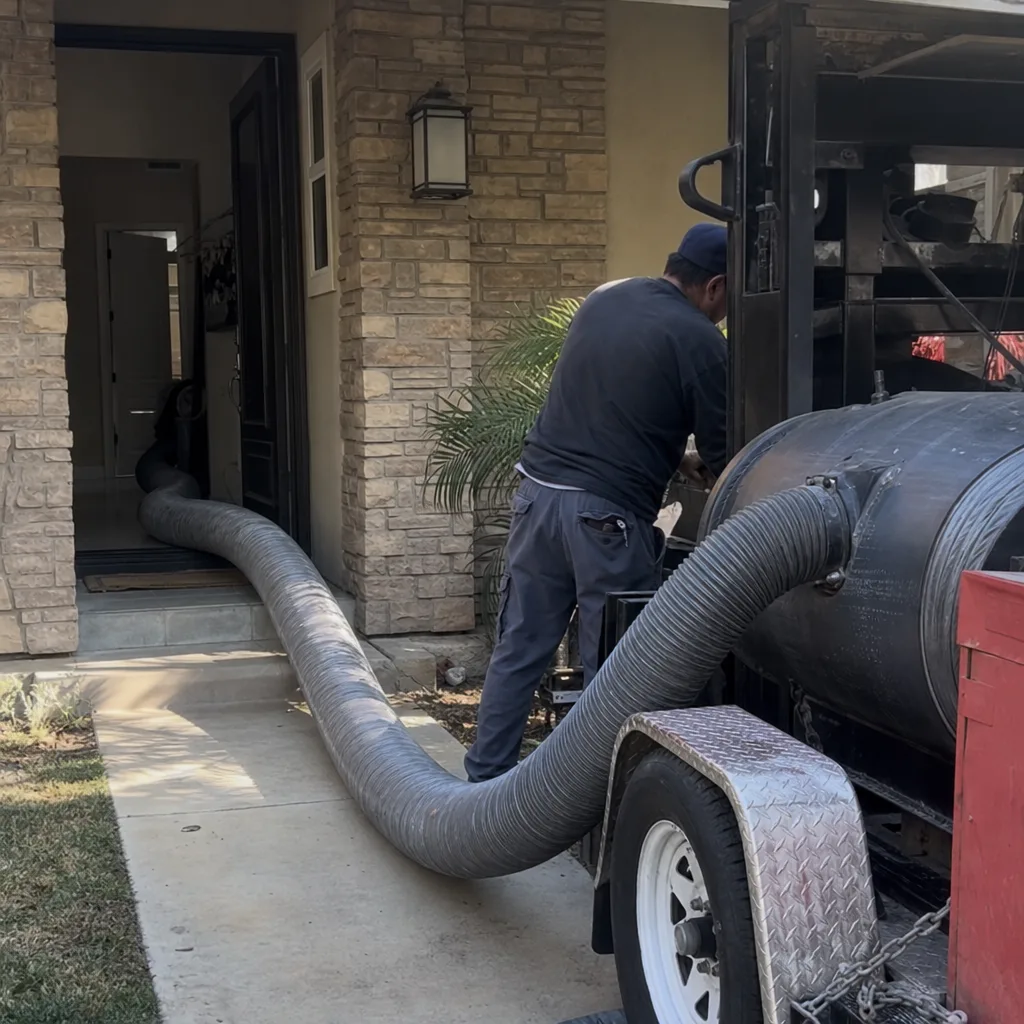
Truck-mounted Nikro systems pull 10,000 to 15,000 CFM (cubic feet per minute) of airflow through the ductwork. Portable systems connected to a home electrical outlet typically pull 1,500 to 4,000 CFM. That’s not a minor difference. Higher CFM means the system can maintain negative pressure even when branch lines are agitated, capturing loosened debris at the collection point rather than letting it resettle in the duct. A low-CFM portable unit can agitate debris off the duct walls, but it may not have the airflow velocity to carry that debris all the way to the collection point. The debris loosens, settles, and re-adheres within weeks.
HEPA-rated negative-air equipment adds another dimension. Abatement Technologies systems include HEPA filtration on the exhaust side, which means the air returned to the home during the cleaning process is filtered to hospital-grade standards. Cheaper setups may exhaust into the attic or out a window without HEPA filtration, which is acceptable for much of the debris but not for the finest particulate, mold spores, or allergen carriers. If you have allergy concerns in your Orange home, this is the difference that matters.
The cost of running this equipment is real. Truck-mounted systems require fuel, maintenance, and a larger vehicle. The technician needs more training to operate them correctly. When you pay $600 for a cleaning using a Nikro truck-mounted system, part of that price is the equipment’s ability to pull the system clean in one pass. When you pay $199 for a portable blower job, you’re paying for a service that may not move enough air to do the job. The Dryer Vent Cleaning in Orange work we do uses the same principle: proper airflow matters, and the equipment determines whether the job is actually done.
We name our equipment brands in this guide because equipment transparency is part of honest pricing. Ask any contractor what system they use and what CFM it pulls. If they can’t answer, you have your answer.
Common Add-Ons and How to Evaluate Each One
Once a base cleaning price is established, most Orange contractors present add-ons. Some are legitimate. Some are conditional. One is usually a separate trade. Here’s how to evaluate each line item when it appears on a quote.
Dryer Vent Cleaning
Dryer vent cleaning is a legitimate add-on that addresses a documented safety risk. The U.S. Fire Administration attributes thousands of residential fires annually to dryer vent buildup, and lint accumulation is the primary cause. If your Orange home’s dryer is more than 15 feet from the exterior wall, or if the vent route makes multiple turns, this service is not optional. Expect to pay $75 to $150 when bundled with a duct cleaning, or $100 to $200 as a standalone. Crisp Duct Cleaning offers this as its own service, because a safety issue deserves dedicated attention.
Antimicrobial Treatment
Antimicrobial or sanitizing treatments are conditional. They make sense if the technician finds mold growth, biological contamination, or evidence of rodent activity in the ductwork. They make no sense as a blanket add-on to a clean system. In Orange’s coastal-influenced climate, humidity levels are moderate, but homes with compromised insulation or prior water intrusion may develop microbial growth. If a contractor recommends treatment, ask to see the area that warrants it. We use treatment only when the evidence justifies it, and we show you that evidence before we apply anything.
UV Light Installation
UV light installation is a separate trade. UV systems are installed at the evaporator coil or in the return plenum to control microbial growth on wet surfaces, and they work best when integrated into the HVAC system by someone who understands airflow and coil design. Some duct cleaning contractors will offer UV installation as an add-on. It’s a legitimate IAQ product, but evaluate it as you would any HVAC modification: ask about bulb replacement intervals, placement rationale, and whether it addresses a specific problem in your home. Honeywell and Aprilaire both manufacture IAQ systems that integrate with ductwork, and our technicians are trained on how these systems interact with a cleaned duct system.
Whole-House Fan or HVAC Tune-Up
Some quotes bundle an HVAC tune-up or filter replacement. This is convenience pricing. If the price is reasonable, it’s a convenience. If the tune-up adds $200 and includes nothing but a filter swap and a visual check, you’re paying for a line item that doesn’t produce measurable results. Ask what the tune-up includes.
Our position on add-ons at Crisp Duct Cleaning is simple: we recommend what we’d want in our own Orange homes, and we show you the evidence before we ask you to spend anything. No fear-based upselling. No treatment without demonstrated cause.
Repair Cost Integration: When Cleaning Reveals Damage
Duct cleaning sometimes uncovers problems that cleaning cannot solve. The difference between a company that cleans and leaves and one that diagnoses and fixes is the difference between a service visit and a system solution. This is where Orange homeowners often see quotes jump from $500 to $1,200 or more, and it’s important to understand why.
Flex duct replacement is the most common repair we encounter in Orange homes. Flex duct has a lifespan of 15 to 25 years, less if it’s been exposed to attic heat extremes or if it was installed with tight bends. During cleaning, damaged flex duct can tear, separate at the collar, or collapse internally. Replacing a flex run costs $150 to $400 per run depending on length and accessibility, and it’s often the only way to restore proper airflow to a room. A conscientious technician will show you the damage and give you the option before proceeding.
Duct sealing addresses air leaks at joints, collars, and plenum connections. In a typical Orange home, 20 to 30 percent of conditioned air can escape through these leaks before it reaches the registers. Mastic sealing or foil tape application costs $200 to $600 depending on the number of accessible joints. This is one of the highest-ROI repairs in the HVAC world, because every dollar spent on sealing returns lower energy bills within a few seasons.
Plenum repair is the most serious repair we encounter. The plenum is the box that connects the air handler to the trunk line. Plenum damage from moisture, pest activity, or poor initial fabrication can undermine the entire system. Repair costs $300 to $800, and it’s not optional work once it’s identified. A cracked plenum will continue to leak air and pull unconditioned attic air into the system.
Here’s the bundling math: having these repairs done during a cleaning visit is almost always cheaper than scheduling a separate repair call later. The access points are already cut, the equipment is on-site, and the technician is already in the duct. At Crisp Duct Cleaning, our Air Duct Repair in Orange service is built around this reality: when a technician finds a problem during cleaning, we can often fix it in the same visit and save you a second trip charge.
2026 Price Anchors for Orange: Line-Item Reference Table
Here’s a structured reference for Orange homeowners comparing quotes in 2026. These ranges reflect local market pricing, not national averages, and they assume licensed, insured contractors using professional-grade equipment.
- Base whole-system cleaning (single-story, 8-12 registers): $350 to $550
- Base whole-system cleaning (two-story or complex access): $500 to $800
- Additional access point (beyond standard): $50 to $100 each
- Dryer vent cleaning (bundled): $75 to $150
- Dryer vent cleaning (standalone): $100 to $200
- Antimicrobial treatment (when warranted): $150 to $350
- Flex duct replacement (per run): $150 to $400
- Duct sealing (mastic, per job): $200 to $600
- Plenum repair: $300 to $800
- Whole-system cleaning with repairs bundled: $700 to $1,500+
These numbers assume a single HVAC system. Homes with two air handlers, common in larger Orange properties or homes with additions, should expect the base price to increase by 60 to 80 percent, not double, since the second system shares some mobilization costs.
Common Mistakes to Avoid
- Comparing quotes by total price alone. A $199 quote and an $800 quote may not be competing for the same job. Compare access points, register count, equipment type, and whether repairs are included before you compare the number.
- Accepting a per-vent price. Legitimate Orange duct cleaning companies price by the system, not per register. Per-vent pricing is a classic bait-and-switch mechanism: the advertised price covers five vents, then each additional vent adds $30 to $50.
- Skipping the question about equipment. Ask what system the contractor uses and what CFM it pulls. If they can’t answer, they’re probably using a portable blower that won’t achieve proper negative pressure.
- Ignoring signs of damage because the quote didn’t include repair. If you know a room has weak airflow, tell the contractor before they quote. Discovering damage during cleaning changes the scope, and the best contractors price for the work they’ll actually do.
- Assuming a low price means good value. In Orange’s competitive market, low-price duct cleaning is often a loss leader designed to get a technician in the home to upsell. The cleaning itself may be cursory, and the upsell becomes the real invoice.
- Paying for antimicrobial treatment without seeing evidence. Treatment has legitimate uses, but it should never be a default. Ask to be shown the contamination before approving the charge.
- Not asking about before-and-after photos. A legitimate company can show you the inside of your ducts before and after cleaning. If they won’t or can’t, you have no way to verify the work was done.
When to Call a Professional
Some situations call for a professional assessment rather than more online research. If your Orange home has visible mold growth around registers or inside the return plenum, call a professional before running the system. If you notice rodent droppings, nesting material, or unexplained odors coming from the vents, that’s a contamination issue that needs professional containment. If rooms in your home have persistently weak airflow despite a tuned HVAC system, the problem is likely in the ductwork itself, and a cleaning-plus-repair visit will identify it. And if you’ve completed a renovation in Orange, drywall dust and construction debris in the ducts is a given – not a maybe.
Crisp Duct Cleaning offers free estimates in Orange. If you want to know what your specific system needs and what it will cost, call (833) 593-4428. We’ll walk through your home’s configuration, answer equipment questions, and give you a real quote based on your actual ductwork.
Frequently Asked Questions
Air duct cleaning in Orange CA in 2026 typically costs $350 to $800 for a legitimate single-system cleaning of an average home, with larger homes and those requiring repair work running $700 to $1,200 or more. Quotes below $300 usually indicate a limited-scope visit rather than a full-system cleaning. Call (833) 593-4428 for a free estimate on your specific home.
Cheap quotes almost always mean less scope: fewer access points, portable equipment instead of truck-mounted negative-air systems, and no repair capability. The contractor may be using the low price to get a technician in the home, after which the real invoice accumulates through add-ons. A legitimate quote itemizes what’s included, and the cheapest quote rarely survives that comparison.
Ask for before-and-after photos of your duct interior from the same access point. Professional-grade equipment includes inspection cameras or borescopes, and a legitimate company should be able to show you the register interiors, trunk line, and return plenum before and after cleaning. If a company can’t provide visual verification, treat that as a red flag regardless of price.
Look for truck-mounted negative-air systems from manufacturers like Nikro that pull 10,000 to 15,000 CFM, or portable systems with HEPA-rated filtration from companies like Abatement Technologies that capture contaminants rather than recirculating them. The equipment name matters because it tells you the system can actually maintain negative pressure throughout your ductwork. Consumer-grade blowers and shop vacs cannot achieve the airflow needed for a full-system cleaning.
The NADCA (National Air Duct Cleaners Association) recommends cleaning every 3 to 5 years for most homes, but Orange-specific factors can shorten that window. Homes near the 55 or 22 freeways, homes with pets, and homes that have undergone renovation should consider cleaning every 2 to 3 years. Homes with residents who have significant allergy or respiratory conditions may benefit from the shorter interval regardless of other factors.
Standard homeowners insurance in California does not cover routine air duct cleaning, because it’s classified as maintenance rather than a covered peril. However, if your ducts were contaminated by a covered event, such as fire smoke, water damage from a burst pipe, or a contractor’s negligence during renovation, your policy may cover cleaning and repair. Contact your insurer with documentation of the event before scheduling the service.
The Bottom Line
Air duct cleaning in Orange is a service where the price tells you less about the contractor’s profit margin and more about their equipment, their access strategy, and whether they’re prepared to repair what they find. A legitimate quote specifies access points, register count, equipment type, and whether repair work is bundled. A suspicious quote hides behind a low number and a list of unspecified add-ons. When you understand what moves the price, you can compare quotes on equal footing. And when the technician uncovers damage that cleaning can’t fix, a company that repairs what it finds saves you a second visit and a second bill. Call (833) 593-4428 for a free estimate from a company that names its equipment and shows its work. Explore more guides & resources on our blog.
Written by the team at Crisp Duct Cleaning, serving Orange since 2012.