
Last updated November 2, 2026
Whole-system duct and dryer vent check with before-and-after photos - you see exactly what came out of your vents
That "$99 whole-house special" is a bait ad - the real number appears once they are in your hallway, or the "clean" is a shop-vac at the register. We photograph the inside of your ducts before and after instead.
Air Duct Cleaning Permits, Codes & Inspections in CA: What You Need to Know
Ask your duct cleaning contractor if they pulled a permit and most will say no, which is usually correct. But if that same visit included duct board repairs, flex duct replacement, or any work on the air handler, “no permit” may have just become your problem at resale. In Orange, we’ve seen homeowners discover unpermitted mechanical work only when a buyer’s inspector flags it during escrow, often weeks after the cleaning invoice was long forgotten. This guide draws the line between what needs a permit, what doesn’t, and how to protect yourself before the work starts.
Quick Answer
Air duct cleaning alone does not require a permit anywhere in California, including Orange. The moment a contractor cuts into ductwork, replaces duct sections, modifies the plenum, or touches the air handler, California Building Code Title 24 and Orange municipal code may require a mechanical permit. If you’re only having ducts cleaned with a negative-air system, no permit is needed; if repairs are on the table, ask whether a permit will be pulled before any work begins.
Styles & brands we work with
- Whole-home duct cleaning
- Dryer vent cleaning
- Camera inspection
- Sanitizing & deodorizing
Table of Contents
- Cleaning vs. Repair: Where the Permit Line Actually Is
- California Title 24: What Governs Duct Work in Orange
- How Orange Building Department Handles Mechanical Permits
- How to Verify Permit History for HVAC Work on Your Orange Property
- Questions to Ask a Duct Contractor Before Work Starts
- Selling an Orange Home with Unpermitted Duct Work: Disclosure Rules
- How to Remediate Unpermitted Mechanical Work in Orange
- What an Inspector Actually Checks on Duct Systems
Cleaning vs. Repair: Where the Permit Line Actually Is
Duct cleaning in Orange is a maintenance activity, no different in the eyes of the City than cleaning your gutters or replacing an air filter. You’re removing accumulated dust, debris, and biological growth from the interior surfaces of existing ductwork. No permit is required for that, and any contractor who tells you otherwise is either misinformed or inflating the job’s complexity to justify a higher price.
What changes the picture is any physical alteration to the duct system. Once a contractor cuts into the duct board, removes a rusted section of sheet metal, pulls out collapsed flex duct and installs a new run, or reconfigures the plenum connection at the air handler, you’ve crossed from maintenance into mechanical work. The California Mechanical Code, which is part of Title 24, treats duct installation and modification as a regulated scope of work requiring a mechanical permit in jurisdictions that adopt the model code, and Orange does.
The distinction matters for one simple reason: when you sell your home, a diligent buyer’s inspector will check whether the visible mechanical work matches the permit record. Unmatched work becomes a negotiating tool against you, or worse, a deal-breaker. We’ve seen homeowners in Orange Park Acres and the Old Towne historic district lose thousands at closing because a previous “duct cleaning” visit included a boot replacement that was never permitted.
Here’s the practical rule we tell our customers: if the only thing happening is air moving through your existing ducts and debris being pulled out, you’re in maintenance territory. If any duct material is being cut, replaced, or reconfigured, ask for the permit.
What Counts as Cleaning (No Permit Needed)
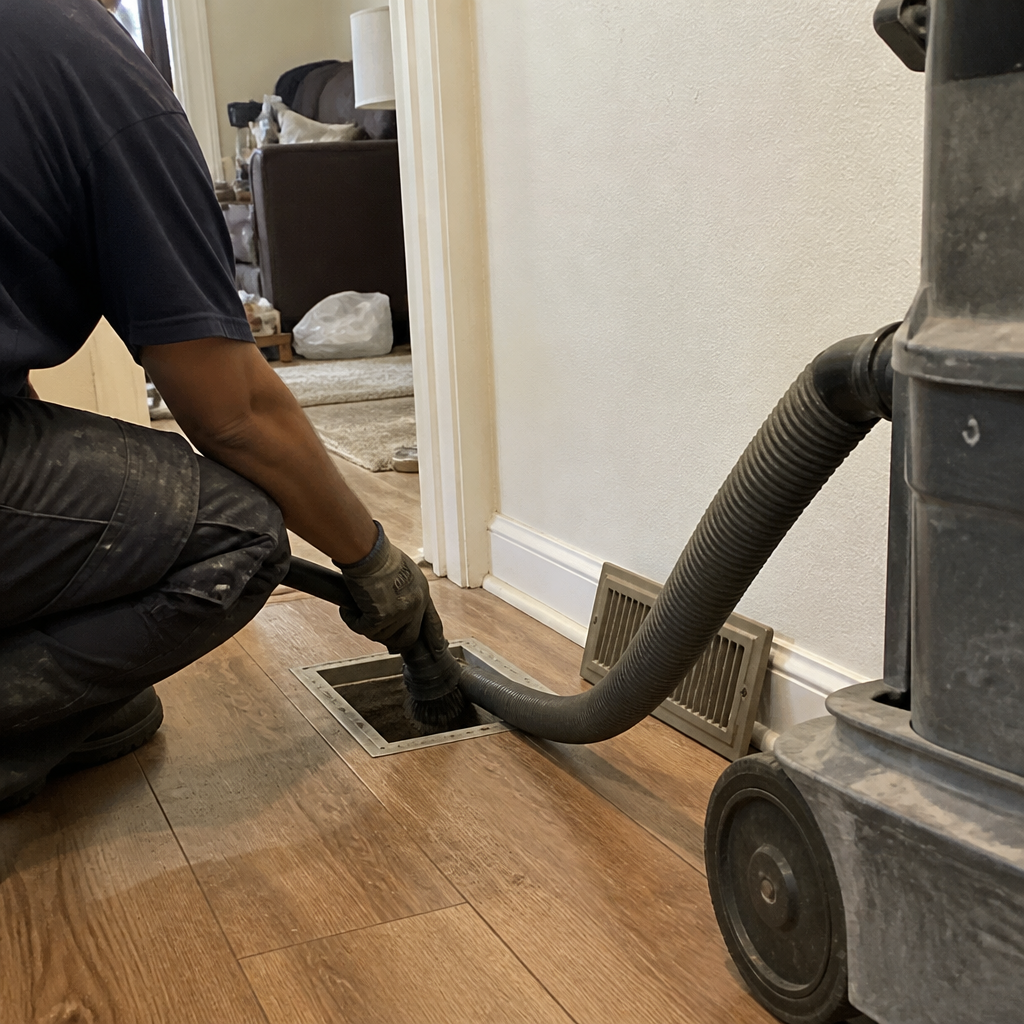
- Negative-air extraction of dust and debris from existing ductwork using HEPA-filtered equipment
- Rotary brush agitation of duct interiors to dislodge settled particles
- Application of EPA-registered antimicrobial coatings to cleaned duct surfaces
- Replacement of the system air filter or access panel gaskets
- Vacuum collection of debris from return registers and supply boots
What Counts as Repair or Modification (Permit Likely Required in Orange)
- Cutting out and replacing damaged duct board sections
- Replacing a run of flex duct that has collapsed or torn
- Installing a new damper or replacing a failed one inside the duct line
- Modifying the plenum connection at the air handler
- Adding a new supply branch or return
- Sealing duct joints with mastic when the seal is intended to remain as a permanent repair, not part of a cleaning service
The sealing point trips up a lot of Orange homeowners. Simple duct sealing as part of an energy-efficiency measure may fall under Title 24’s building energy efficiency standards, and if the sealing work is extensive enough to count as an alteration, Orange’s inspection division may want a look at it. We always clarify scope before the job starts so there’s no ambiguity later.
California Title 24: What Governs Duct Work in Orange
California’s Title 24, the California Building Standards Code, is the state’s collection of construction regulations. Within it, the California Mechanical Code governs heating, ventilation, and air conditioning systems, including ductwork. For homeowners, the relevant sections are those that address duct installation, duct material standards, and duct sealing requirements, and they’re not written as suggestions.
The California Energy Code, also part of Title 24, requires that duct systems in new construction and major alterations meet specific leakage standards. If a contractor replaces a section of duct in an existing Orange home, the replacement work is supposed to comply with current code, which includes sealing all accessible joints with mastic or approved tape and verifying that the replacement materials match or exceed the original specification. Homeowners often assume that a repair just needs to “work,” but the code cares about air leakage, fire safety, and energy loss.
One of the most commonly cited sections in Orange HVAC work is CMC Section 601, which covers general duct construction. It specifies minimum sheet metal gauges, acceptable materials for duct board, and support spacing. If a contractor replaces a rusted section of metal duct with material thinner than code allows, the repair may fail an inspection and create an unpermitted condition you inherit.
Our technicians work with duct systems in Orange homes built across a wide range of eras. Pre-1970s homes often have original metal ductwork still in service, while 1990s and 2000s homes frequently have flexible ducts that degrade faster in Orange’s summer heat. Different eras mean different failure modes, and the code requirements for fixing them differ as well.
Title 24 also addresses air handler clearances, return air pathways, and combustion air for gas-fired furnaces. A duct modification that changes airflow to a furnace can inadvertently create a safety concern, which is another reason Orange’s building department takes mechanical permits seriously. It’s never just about the duct. It’s about the system the duct serves.
How Orange Building Department Handles Mechanical Permits
The City of Orange Community Development Department oversees building permits, including mechanical permits, for work within city limits. Like most Orange County cities, Orange operates its own building department rather than relying on the county, which means local codes and local interpretations matter.
In practice, a mechanical permit in Orange is issued after a contractor or homeowner submits a permit application describing the scope of work. For simple duct repairs, the application might be a one-page form with a brief description of the replacement. For larger alterations, the city may require a plan showing the affected duct runs, the replacement materials, and the connection points. Fees are based on the valuation of the work, and the process typically moves faster than homeowner expectations.
Orange’s inspectors are known for being practical but thorough. On a typical duct repair inspection, they’re checking that the replacement material matches what was described on the application, that duct joints are sealed with approved mastic or tape, that supports are spaced per code, and that the work doesn’t conflict with structural elements or other mechanical systems in the attic or crawlspace.
One thing we’ve learned from years of working with Orange inspectors: they care about access. If a permit is pulled for duct work, the inspector needs to actually see the work. That means the attic hatch or crawlspace entry needs to be accessible, and the contractor needs to schedule the inspection while the work is still visible. Homeowners who choose contractors unfamiliar with Orange’s process often end up with a failure simply because the inspector couldn’t reach the work or the job was buried behind insulation before the inspection happened.
For anyone planning major duct replacement in Orange, it’s worth checking whether the city’s current adopted code cycle includes any local amendments. Orange periodically updates its municipal code to reflect changes in Title 24, and local amendments can affect material requirements or inspection procedures. The city’s website maintains a list of current adopted codes, and the building department counter staff will answer questions directly.
How to Verify Permit History for HVAC Work on Your Orange Property
Checking your property’s permit history in Orange is free and takes about ten minutes, yet almost nobody does it before hiring a contractor or before listing a home for sale. The City of Orange maintains a public permit portal where you can search by property address and review issued permits, inspection results, and any open code enforcement actions. If you’re unfamiliar with the portal, the building department counter at City Hall can pull the same records.
Here’s the step-by-step process we recommend to Orange homeowners:
- Visit the City of Orange Community Development Department’s building permit search page.
- Enter your street address exactly as it appears on your property tax bill, using the same abbreviations the city uses.
- Review the list of permits associated with your address. Mechanical permits are typically labeled “M-Permit” or similar, and the description field will list the scope.
- Compare the permit descriptions to any work you know has been done on your HVAC system. Look specifically for duct installations, air handler replacements, or alterations.
- If you find work that isn’t in the permit record, note the date, scope, and the contractor’s name if you have it. That information matters for disclosure and remediation.
- If you’re preparing to sell, request a copy of the permit history directly from the city so you have it in writing for the disclosure package.
One caution: some Orange homeowners discover that a previous owner did work without a permit and then sold the home without disclosing it. California law requires sellers to disclose known material facts about the property, and unpermitted work that affects the mechanical system qualifies. If you discover unpermitted work now, you’re better positioned to address it before it becomes someone else’s transaction problem.
Questions to Ask a Duct Contractor Before Work Starts
You should be able to ask these questions in a five-minute phone call and get direct answers. If a contractor hedges, gets defensive, or tells you not to worry about permits, that’s your signal to keep looking.
- “Does the scope of work you’re proposing include any duct modification, replacement, or repair?” This is the question that splits maintenance from regulated work. The answer should be specific: “We’re cleaning only” or “We’re replacing a 12-foot run of flex duct in the attic.”
- “If repairs are needed, will you pull a mechanical permit with the City of Orange?” A contractor doing legitimate repair work in Orange should have no problem with this question. The answer should be an immediate yes, with a note about permit fees being included in the quote.
- “Can you describe exactly what happens if you find damage during the cleaning?” This is where the line gets blurry. Some contractors will stop and discuss options. Others will quietly patch a problem and bill for it without ever mentioning permits. You want the first kind.
- “What equipment are you using?” This is less about permits and more about competence. We run Rotobrush and Nikro duct cleaning systems with Abatement Technologies negative-air HEPA filtration. If a contractor shows up with a shop vac and a flexible brush, they’re not equipped for a serious cleaning job in an Orange home, and they may not understand the code implications of the repairs they’re likely to botch.
- “Are you familiar with Orange’s inspection process?” If permits are involved, the contractor should know the drill: submit application, schedule inspection, make sure the work is accessible, and ensure the inspector signs off. A contractor who claims permits are “just a formality” is wrong.
In our experience, the contractors who answer these questions well are the ones who also handle the rest of the job professionally. The questions take minutes to ask and can save you from a resale nightmare years later.
Selling an Orange Home with Unpermitted Duct Work: Disclosure Rules
California Civil Code Section 1102 requires sellers to complete a Transfer Disclosure Statement, and that document includes questions about work performed on the property and whether it was permitted. If you know that duct work was replaced or modified without a permit, and you fail to disclose that fact to a buyer, you’ve created liability exposure that can follow you long after the sale closes.
The practical question for most Orange sellers is how to handle the disclosure. Here’s the honest version: you disclose it. The form asks specifically whether you’re aware of any room additions, structural modifications, or other alterations made without a permit. Mechanical work falls under “other alterations” in most interpretations, and a buyer’s agent will push for full transparency.
Buyers in Orange’s competitive market are increasingly sophisticated. Many hire inspectors who specifically look for signs of unpermitted work: mismatched duct materials, newer flex duct that doesn’t align with the home’s age, mastic sealing that doesn’t appear on any permit record, or furnace closet modifications that don’t match any historical permit. When those findings surface in an inspection report, the buyer’s first call is to the building department, and the seller’s negotiating position deteriorates immediately.
Disclosing unpermitted duct work doesn’t necessarily kill the sale. It changes the terms. Buyers may request a credit, ask the seller to obtain a retroactive permit, or adjust the price. What sinks deals is the discovery process, where the buyer feels misled and the trust evaporates. In a market like Orange, where homes in the Floral Park and Cambridge neighborhoods move quickly, the cleanest path is disclosure followed by remediation or a clear credit.
How to Remediate Unpermitted Mechanical Work in Orange
If you’ve discovered unpermitted duct work in your Orange home, you have several options, and none of them are as difficult as homeowners fear. The City of Orange handles after-the-fact permits regularly, and the process is straightforward if the work is code-compliant or can be brought up to code.
- Determine what work was done and when. Gather receipts, contractor invoices, or photos. If the work was done by a previous owner and you have no records, the city will still work with you.
- Have the work evaluated by a qualified contractor. The evaluator should assess whether the existing duct work meets current Title 24 requirements for materials, sealing, and support. This is where we often help Orange homeowners, because our technicians can identify specific deficiencies and document them.
- Submit an after-the-fact permit application to the City of Orange. The application describes the existing work as it currently exists. The city may require an inspection before approving the permit.
- Schedule the inspection. The inspector will examine the duct work and note any code violations that need correction before the permit can be finalized.
- Make any required corrections and schedule a final inspection. In most cases, corrections are minor: adding a missing support strap, re-taping a joint, or sealing a small gap.
- Keep the finaled permit with your property records. This is the document you’ll show to a future buyer to prove the work is permitted and inspected.
The cost of an after-the-fact permit is based on the same fee schedule as a standard permit, and the fees are modest relative to the cost of a failed escrow. We’ve helped Orange homeowners through this process, and the main obstacle is usually not the city, but the reluctance to start. Once the application is in, the city’s process moves along predictably.
What an Inspector Actually Checks on Duct Systems
If you’ve never sat through a mechanical inspection in Orange, the process can feel mysterious. In practice, an Orange building inspector examining duct work is looking at a specific checklist, and most of the items are straightforward. Understanding what they’re checking helps you prepare and avoids failed inspections.
Here’s what the inspector is typically verifying:
- Material compliance. The replacement duct must match or exceed the original specification. If the original was 30-gauge sheet metal and the replacement is thinner, that’s a flag. For flex duct in attics, the inspector checks that the material is listed for the application and properly supported every four feet.
- Sealing. Joints must be sealed with approved mastic or UL 181-rated tape. Duct tape, the gray fabric version, is not accepted and hasn’t been for decades. We see this failure regularly in Orange attics where a previous handyman used the wrong tape.
- Support and clearance. Ducts must be supported at the spacing required by the mechanical code and kept clear of sharp objects, electrical wiring, and plumbing. In attics, ducts resting directly on ceiling joists without proper hangers are a common citation.
- Air handler clearances. If the duct work connects to an air handler or furnace, the inspector will verify that access clearances meet current code. The duct replacement shouldn’t create a situation where future service is impossible.
- Fire and smoke separation. In homes with attached garages, the inspector checks that any duct penetration through the garage fire wall is properly sealed with fire-rated materials. This is a common finding in Orange homes where a previous owner ran a duct through the garage wall without understanding the fire separation requirements.
For cleaning-only services, none of this applies. That’s the entire point of the cleaning-versus-repair distinction. When we clean ducts in Orange, we’re not altering the system, so no inspector is involved. When repairs are needed, we’re the ones who know what an inspector will look for because we’ve been through the process many times with Orange homeowners.
Common Mistakes to Avoid
- Assuming all duct work falls under “cleaning” because the invoice says so. Some companies use “cleaning” as an umbrella term that quietly includes repairs. Read the scope. If materials are being replaced, the permit question applies.
- Taking “you don’t need a permit” at face value without understanding what work is actually happening. A contractor who says no permit is needed might be right, or might be avoiding the fee and inspection. Ask specifically whether any duct material will be replaced or modified.
- Failing to verify permit history before buying an Orange home. The permit portal is free and public, yet most buyers never check it. A ten-minute search before your offer can reveal unpermitted HVAC work that becomes your problem after closing.
- Letting a contractor reseal duct joints with the wrong material. Gray fabric duct tape degrades and falls off within a few seasons in Orange’s attic heat. Approved mastic or UL 181 tape is what inspectors accept, and it’s what actually holds.
- Not documenting cleaning and repair work separately. If one invoice says “duct cleaning & repair” with no breakdown, you have no way to show a future buyer which part was maintenance and which part was modification. Separating line items costs nothing and avoids ambiguity.
- Assuming a retroactive permit is too expensive to bother with. After-the-fact permits in Orange cost the same as standard permits, which is typically a few hundred dollars depending on scope. Compare that to a failed escrow negotiation.
- Scheduling duct work without confirming the contractor knows Orange’s local process. Orange has its own building department, its own inspection scheduling system, and its own interpretations. A contractor who primarily works in other Orange County cities may not be familiar with Orange’s specifics.
When to Call a Professional
There are situations where the permit question is best handled by someone with experience navigating both the technical work and the Orange inspection process. If you’ve discovered signs of duct modification you can’t trace to a permit, if you’re planning major duct replacement ahead of a home sale, or if a previous contractor did repair work without pulling a permit and you need the situation assessed, call someone who knows what Orange inspectors expect to see. Duct systems in Orange attics degrade differently than in coastal cities, and the correction path depends on the specific material, the specific location, and the specific code cycle. We help Orange homeowners assess their duct systems, determine whether a permit is needed, and handle both the repair and the permitting process. Crisp Duct Cleaning offers free estimates in Orange for Air Duct Cleaning services – call (833) 593-4428.
Frequently Asked Questions
No, air duct cleaning alone does not require a permit anywhere in California, including Orange. Cleaning is maintenance work. A permit is only required when duct materials are cut, replaced, modified, or when the air handler connection is altered, at which point California Title 24 and Orange municipal code may require a mechanical permit. Call (833) 593-4428 for an exact assessment of your Orange home’s duct system.
Duct cleaning is a no-permit maintenance activity because nothing about the duct system changes. Duct repair, which includes replacing duct board, installing new flex duct runs, or modifying plenum connections, is regulated work that may require a mechanical permit in Orange. We handle both services, and when repairs are needed, we’ll tell you upfront whether a permit applies to the specific scope. Call (833) 593-4428 to discuss your situation.
You can check through the City of Orange Community Development Department’s online permit portal by entering your street address and reviewing the mechanical permit history for your property. Any duct installation, air handler replacement, or modification should appear with a permit record. If work exists that doesn’t match the record, it may be unpermitted and should be evaluated before you sell. Call (833) 593-4428 for guidance on next steps.
California law requires you to disclose known material facts about the property, including unpermitted mechanical work, on the Transfer Disclosure Statement. Failure to disclose doesn’t eliminate the liability, it just transfers a lawsuit risk to you. Buyers increasingly inspect for unpermitted work, and undisclosed findings often derail transactions or trigger price renegotiations. Remediation through a retroactive permit is usually the cleanest path. Call (833) 593-4428 to have your duct work evaluated.
Yes, the City of Orange processes after-the-fact permits for existing duct work. The process involves submitting an application describing the existing work, scheduling an inspection, and correcting any code deficiencies the inspector identifies. Most corrections are minor, and once the permit is finalized, the work is treated as fully permitted. We’ve guided Orange homeowners through this process and can assess what corrections your system is likely to need. Call (833) 593-4428.
An Orange mechanical inspector checking duct work verifies material compliance, joint sealing with approved mastic or UL 181 tape, proper support spacing, air handler clearances, and fire separation at garage wall penetrations. Duct work that was sealed with gray fabric duct tape, supported incorrectly, or routed through a garage wall without fire-rated materials will fail inspection. We know what Orange inspectors check because we’ve gone through the process repeatedly with local homeowners. Call (833) 593-4428 to schedule duct cleaning, repair, or a permit assessment.
The Bottom Line
Duct cleaning in California requires no permit, but duct repair often does, and the difference matters most at resale. Orange homeowners who understand this distinction can hire contractors with confidence, ask the right questions before work starts, and avoid unpermitted work that surfaces later as a negotiation liability. If your scope is cleaning only, no permit is needed and no inspector is involved. If repairs are on the table, ask whether a mechanical permit applies, verify what work has been done on your property, and document everything. A clean duct system and a clean permit record together are what make your Orange home sell for the price it should. For more guides & resources on protecting your home’s value, visit our blog.
Written by the team at Crisp Duct Cleaning, serving Orange since 2012.
For more about our services, visit the Crisp Duct Cleaning home page. We offer Air Duct Cleaning in Orange, Dryer Vent Cleaning in Orange, and Air Duct Repair in Orange.