
Last updated November 2, 2026
Whole-system duct and dryer vent check with before-and-after photos - you see exactly what came out of your vents
That "$99 whole-house special" is a bait ad - the real number appears once they are in your hallway, or the "clean" is a shop-vac at the register. We photograph the inside of your ducts before and after instead.
Air Duct Cleaning Maintenance Checklist for Orange Homeowners
If you’re following the “clean every 3-5 years” rule you read online, you’re using a national average written for homes that aren’t yours. Orange homes built in the 1970s with original flex duct, households with three shedding dogs, or anyone who just finished a kitchen remodel may need attention twice as often. This checklist is built around the variables that actually change your maintenance schedule: duct material, system age, occupant allergies, and whether that last Santa Ana event pushed a quarter-inch of fine dust through every register in the house.
We’ll walk through what you can do monthly without tools, what your HVAC tech should check annually, and what a duct specialist needs to assess every 2-4 years. By the end, you’ll have a record-keeping method that makes the next service visit faster and more accurate for any Orange contractor you hire.
Quick Answer
Orange homeowners should do a monthly visual register check and filter inspection, schedule annual HVAC maintenance that includes static pressure testing, and have a full Air Duct Cleaning every 2-4 years depending on duct age, pet count, filter grade, and whether the home has undergone renovation. Homes with older flex duct or post-construction debris should lean toward the 2-year mark; homes with MERV 11-13 filtration and no pets can extend toward 4 years. The single most useful habit is logging what you see at each register so changes become obvious between professional visits.
Styles & brands we work with
- Whole-home duct cleaning
- Dryer vent cleaning
- Camera inspection
- Sanitizing & deodorizing
Table of Contents
- Understanding What Your Duct System Actually Is
- Orange-Specific Checklist Triggers Most National Guides Miss
- The Monthly Homeowner Checklist (No Tools Required)
- What Your HVAC Tech Should Check Annually
- The 2-4 Year Duct Specialist Assessment
- Filter MERV Ratings and Why “Higher Is Better” Can Backfire
- How to Log Duct Conditions Over Time
- Common Mistakes to Avoid
- When to Call a Professional
- Frequently Asked Questions
Understanding What Your Duct System Actually Is
Before any checklist makes sense, you need to know what you’re maintaining. A duct system is not a passive tunnel. It’s a pressure vessel. Your blower motor pushes conditioned air through it at a specific static pressure, and every joint, seam, and bend either holds that pressure or leaks it. Orange homes split roughly into two populations: older houses with flexible duct – the insulated, accordion-style tubing you see in attics – and newer or retrofitted homes with rigid sheet metal duct.
Flex duct ages differently than metal. The inner liner degrades, the outer jacket tears, and the insulation compresses. We’ve pulled flex duct out of Orange attics that crumbled in our hands after 30 years of attic heat cycling. Metal duct corrodes more slowly but leaks at the seams as sealant dries and cracks. Knowing which you have matters because the maintenance questions are different. Flex duct needs visual inspection for sagging and compression. Metal duct needs seam and joint checking. Both need periodic cleaning, but the interval shifts based on material.
Your duct system also includes the return side – the path air takes back to your HVAC unit. Many Orange homeowners check supply registers and forget returns entirely. The return side pulls air from your living space, which means it’s pulling in whatever you generate: cooking grease, candle soot, pet dander, dust from that remodel. If your return registers look dirtier than your supply registers, that tells you something about what’s circulating through the house before it ever reaches the filter.
This guide from the Crisp Duct Cleaning home perspective assumes you’re working with a standard central forced-air system. If you have a zoned system or a multi-unit property, the principles scale, but the intervals compress.
Orange-Specific Checklist Triggers Most National Guides Miss
National duct cleaning guides are written for the median American home, which is not an Orange home. Our climate, geography, and housing stock create specific triggers that should override any generic schedule you’ve read elsewhere.
Santa Ana wind events. When the Santa Anas blow, they push fine particulate through every exterior crack, window seal, and door threshold. That dust doesn’t stay at the perimeter of your home. It gets pulled into the return air stream, passes through your filter, and if your filter is a basic fiberglass mesh, most of it continues into the duct system. After a multi-day Santa Ana event, walk your house and check registers. If you see a fine tan silt building up at the vent edges, that’s San Gabriel mountain dust that has already transited your system. One event won’t ruin your ducts. A decade of them, with no cleaning, will leave a measurable layer on the duct walls. Track Santa Ana events in your duct log. After two or three major blows, lean toward the shorter cleaning interval.
Post-renovation inspection. Drywall dust doesn’t behave like regular household dust. It’s finer, it’s abrasive, and it gets sucked into the return side during any renovation that involves cutting, sanding, or demolition. Even with contractors running plastic barriers and zip walls, the HVAC system pulls negative pressure from the work zone. After a remodel, check the return grilles first. If you can wipe drywall dust off the return grille with your finger, that dust has already entered the system. A full Air Duct Cleaning in Orange should follow any substantial remodel – not as a luxury, but as a mechanical necessity. Drywall dust in a blower motor bearing shortens the life of the motor. In a duct system, it clings to the walls and becomes a permanent resident unless physically removed.
Post-rodent evidence. Orange attics host rats, mice, and the occasional squirrel. If you’ve had rodent activity – droppings in the attic, scratching sounds, a dead animal removed – your ducts need inspection. Rodents chew through flex duct outer jackets, nest in the insulation, and sometimes die inside the duct run. The smell is unmistakable. But even without the smell, rodent droppings in or around ductwork are a health hazard and a reason for professional cleaning. This is not a monthly checklist item. It’s an event-triggered item that jumps the queue ahead of whatever schedule you were on.
Age of the home. Orange has a significant stock of homes built between 1950 and 1980. These homes often have original duct systems or decades-old replacements. If your home is 40+ years old and you’ve never replaced the ducts, assume they’re leaking at 20-30% efficiency loss. Cleaning them is still worthwhile, but understand that a 45-year-old duct system may need Air Duct Repair in Orange to truly perform. Cleaning a leaky duct system is like patching a tire with a hole in the sidewall. The repair conversation should happen alongside the cleaning conversation.
The Monthly Homeowner Checklist (No Tools Required)
These are the items you can do in ten minutes on a Saturday morning with nothing but your eyes, your phone camera, and maybe a flashlight. The goal is not deep inspection. The goal is building a baseline of what “normal” looks like so that “abnormal” jumps out immediately.
- Walk the perimeter and look at every supply register. You’re looking for three things: visible dust accumulation on the register face, dust staining on the wall or ceiling around the register, and any musty smell when the system runs. Take a phone photo of anything that looks unusual. This is your log entry for the month.
- Check the return grille or grilles. Returns pull air in, so they collect everything in the air column. A dirty return grille is normal. A return grille that is clean while your supply registers are dirty tells you the filter is catching everything and the supply side may be shedding old accumulation. Note which direction the dirt runs.
- Look at the filter. You don’t need to replace it monthly unless it’s visibly loaded. But you should look at it. If a filter installed 30 days ago is black or gray along the edges, you have either a high-particulate environment or a duct system that is blowing debris forward. A filter that loads up in under a month means your ducts are dirty, your home is dusty, or your filter is undersized for the system.
- Listen to the system when it starts. A properly sealed duct system makes a steady air noise. A hissing, whistling, or rattling sound at registers suggests leaks, loose dampers, or obstruction. If you hear a new noise, note it in your log with the date.
- Feel for airflow balance. Walk the house while the system runs and put your hand near each register. Rooms should feel roughly equivalent. One room with noticeably weaker airflow than the others suggests a collapsed duct run, a disconnected joint, or a damper that has shifted. This is a common post-Santa Ana issue in Orange attics – wind can shift loose duct runs out of alignment.
None of these steps require tools or technical knowledge. What they require is consistency. A single month of observation tells you almost nothing. Six months of monthly observation gives you a baseline you can hand to any contractor who comes to your home, and that baseline is worth real diagnostic time.
What Your HVAC Tech Should Check Annually
Your annual HVAC maintenance visit is not a substitute for duct cleaning, but it should include several checks that directly affect duct health. If your current HVAC tech isn’t doing these, ask them to start. If they won’t, find one who will.
- Static pressure test. This is the single most important measurement for duct system health, and most homeowners have never heard of it. Static pressure measures resistance to airflow. A system running at high static pressure is working harder than it was designed to, which shortens blower motor life and increases energy consumption. The reading also tells you whether your filter is too restrictive for the system. This matters directly for the filter discussion below.
- Duct leakage assessment. A good tech can identify major leaks using visual inspection, smoke pencils, or a simple pressure test. In Orange attics, the most common leak points are at register boots, plenum connections, and anywhere flex duct meets a metal collar. A 15% duct leak means 15% of the air you’re paying to condition is going into the attic instead of the living room.
- Condensate drain and coil check. Your indoor coil sits in the air stream. If it’s dirty, it sheds moisture and biological growth into the duct system. If the condensate drain is plugged, water backs up into the drain pan and creates a humid environment that supports mold and mildew growth – which then circulates through the ducts. An annual coil inspection protects the entire system downstream.
- Filter housing inspection. The filter rack or housing matters as much as the filter itself. A filter housing that allows air to bypass around the edges means unfiltered air enters the coil and duct system. This is a common issue in older Orange homes where filter racks were retrofitted or never properly sealed.
- Blower motor inspection. Dust accumulation on the blower wheel reduces airflow and throws the wheel out of balance. A dirty blower wheel is also a sign that the filtration system is failing and particulate has been reaching the motor for an extended period.
Annual HVAC maintenance typically costs $150-$350 in the Orange area, depending on the system and the company. That’s the cheapest insurance you can buy for your duct system. Every one of these checks catches problems that become expensive if left alone for five years.
The 2-4 Year Duct Specialist Assessment
Every 2-4 years – depending on the variables we’ve discussed – a duct specialist should perform a full assessment of the system. This is not the same as an HVAC maintenance visit. A duct specialist goes into the attic or crawl space and looks at the duct runs themselves, which most HVAC techs never touch during a standard tune-up.
What a full specialist assessment includes:
- Visual inspection of every accessible duct run. Flex duct gets checked for sagging, compression, kinking, and outer jacket tears. Metal duct gets checked for seam separation, rust, and sealant failure. In Orange attics, we regularly find flex duct that has been compressed by storage items, weighed down by accumulated dust, or chewed through by rodents.
- Register and boot inspection from inside the duct. Debris accumulates at register boots even when the central runs look clean. A camera inspection of the boots shows what’s actually there.
- Coil and blower chamber inspection upstream and downstream. The duct system is only one part of the air path. The coil sits upstream of the supply ducts. The blower sits at the start of the whole system. Both contribute to what reaches your living space.
- Airflow measurement at multiple points. A competent specialist can measure airflow at the return, the plenum, and several supply registers. The numbers tell you whether the system is moving the air it was designed to move, and where the losses are.
- Assessment of contamination type. Not all duct debris is the same. Household dust is one thing. Drywall dust is another. Biological growth is a third. Soot from candles or a fireplace is a fourth. Rodent contamination is a fifth. The cleaning approach differs based on what’s actually in the system, and a specialist should be able to tell you what they’re seeing.
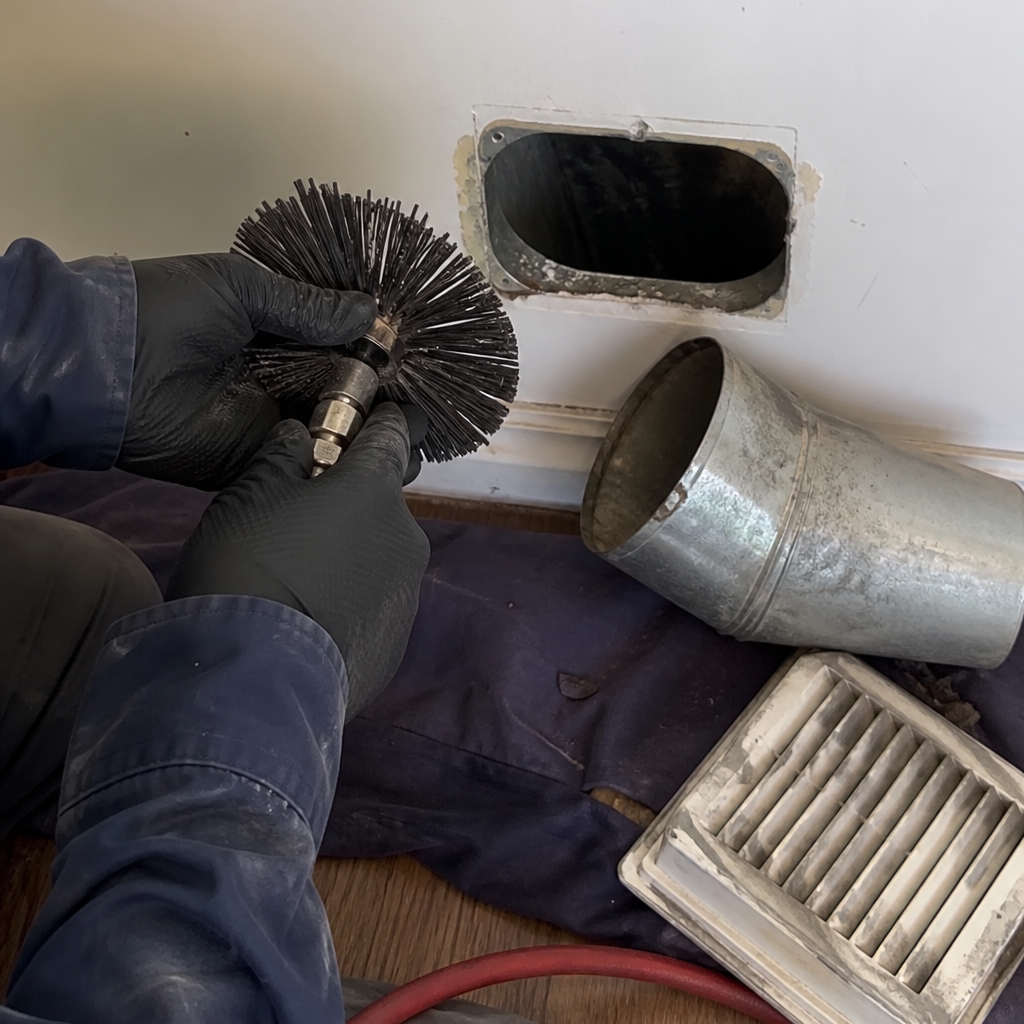
When we perform this assessment in Orange homes, the unit we use matters. Our Rotobrush and Nikro systems are purpose-built duct cleaning machines – not a shop vac with a hose attached. The difference is contact. These systems physically agitate the duct walls and extract the loosened debris into a contained system. Combined with Abatement Technologies negative-air equipment, the process captures debris rather than redistributing it through the house. That’s what “full-system cleaning” actually means: agitate, extract, contain. Not blow it around and call it done.
If the assessment finds damaged ductwork – and in Orange homes over 20 years old, it often does – that’s where repair capability matters. A cleaning-only company sees a tear in the flex duct and has to tell you to call someone else. Our team can repair the ductwork in the same visit. For Orange homeowners, that’s the difference between a one-visit fix and a two-company project that stretches across weeks.
Filter MERV Ratings and Why “Higher Is Better” Can Backfire
One of the most common mistakes we see in Orange homes is a homeowner who bought a MERV 13 filter after reading an article about indoor air quality, installed it in a system that was never designed for it, and created a cascade of problems downstream. Here’s what actually happens.
MERV stands for Minimum Efficiency Reporting Value. The scale runs from 1 to 16 for residential filters. A basic fiberglass filter is MERV 1-4 and stops large debris only. A MERV 8 filter catches pollen and dust mites. A MERV 11 catches most pet dander, mold spores, and fine dust. A MERV 13 catches essentially everything above a certain micron size, including some bacteria and virus-carrying particles.
The tradeoff is resistance. Every step up the MERV scale adds resistance to the air stream. Higher resistance means higher static pressure, which means the blower motor works harder, moves less air, and may overheat in extreme cases. On older Orange homes with undersized return ducts – a common issue in 1960s and 1970s construction – a MERV 13 filter can push static pressure past the design limit of the unit. The blower strains. The coil gets less airflow. Efficiency drops. In the worst case, the motor burns out years early.
If you want to run a MERV 11-13 filter, have your HVAC tech check static pressure first. This is a $0 add-on to an annual maintenance visit – the tech already has the manometer out. If static pressure stays within range with the higher filter, you’re clear. If it spikes, you have two options: drop back to MERV 8, or address the underlying airflow issue by enlarging the return or adjusting the system.
The same logic applies to whole-house filtration systems. We service Honeywell and Aprilaire IAQ units in Orange homes. These are excellent products, but they need to be matched to the system’s airflow capacity. A whole-house media filter or electronic air cleaner installed on an undersized return duct creates the same static pressure problems as a too-restrictive panel filter, just at higher cost. The right approach is measurement first, equipment second.
One more specific note for Orange: our dust is fine. Santa Ana particulate is smaller than the lint and hair you’d find in a humid climate. A MERV 8 filter may not catch this fine dust effectively. If you’re in a high-wind corridor – near Chapman Avenue East, around the hills in Villa Park, or anywhere on the east side of the 55 – you may notice finer dust accumulation than friends in more sheltered areas. That’s real, it’s local, and it moves the needle on both filter choice and cleaning interval.
How to Log Duct Conditions Over Time
The most underrated maintenance habit in any Orange home is making records. Contractors can only see what the system looks like today. You’re the only person who sees it every month. A simple log turns your observations into a diagnostic tool that saves hours of guesswork when you finally call a professional; for additional help, see our more guides & resources.
Your log doesn’t need to be elaborate. A notes app, a spreadsheet, or a paper notebook all work. The key is consistency of format. Here’s a template that takes two minutes per month:
Date: [Month, Year]
Filter checked: Clean / Lightly loaded / Heavy – replaced?
Supply registers: Clean / Light dust / Heavy dust / Dust staining on walls
Return grille: Clean / Light dust / Heavy dust
Odor: None / Musty / Dusty smell when system starts
Noise: Normal / New hissing / New rattling / New whistle
Airflow: Balanced / Weak in [room]
Over a year, this log shows patterns. If the filter loads faster in October than in March, you know something changed. If a particular register consistently shows more dust than the others, that run has a problem somewhere. If a musty smell appeared in November and hasn’t gone away by January, you have a moisture issue, not a cleaning issue.
The log also helps when you hire a duct specialist. Showing us 12 months of observations tells us where to look first, which saves you money on diagnostic time. A contractor who doesn’t want to look at your log is a contractor who doesn’t understand diagnosis. Find one who does.
For property managers in Orange handling multi-unit buildings, this log is the difference between reactive and proactive maintenance. When a tenant reports a persistent dust issue, the log for that unit either confirms or rules out a duct system problem before anyone schedules a service call.
Common Mistakes to Avoid
- Treating “3-5 years” as a fixed rule. The national average is a starting point, not a law. Variables in your home – pets, renovations, duct age, filter grade, and Santa Ana exposure – determine whether you need cleaning every 2 years or every 5. Log your conditions and let the data set the interval.
- Bumping to a MERV 13 filter without testing static pressure. High-efficiency filters add resistance to the system. On older Orange homes with marginal return airflow, this can shorten the blower motor’s life and reduce system capacity. Test before you upgrade.
- Checking supply registers but ignoring returns. Return grilles tell you what’s entering the system. If your returns are dirtier than your supplies, the system is ingesting particulate faster than it can filter it. That’s a diagnostic clue, not just a cleaning task.
- Assuming a clean filter means clean ducts. The filter is one stage in a multi-stage system. Duct walls, register boots, the coil, and the blower wheel all accumulate particulate independently. A clean filter says nothing about the state of the rest of the air path.
- Relying on a handyman with a shop vac for duct cleaning. Duct cleaning requires professional equipment that can agitate the full duct wall and extract debris under negative pressure. A shop vac through a register opening agitates the first six inches of duct and calls it done. You get charged for cleaning and receive half a service.
- Postponing cleaning after a renovation because “the house was just cleaned.” Surface cleaning doesn’t address what went into the duct system during construction. Drywall dust in the ducts stays there until mechanically removed. It doesn’t break down, it doesn’t wash away, and it doesn’t get caught by the filter. It either gets cleaned out or it stays.
- Ignoring rodent activity because the animal is gone. Rodent droppings, urine, and nesting material in ductwork are health hazards whether the animal is still present or not. If you’ve had rodents in the attic, have the ducts inspected. Cleaning is cheaper than ignoring it.
When to Call a Professional
Some things on this checklist are DIY. Checking registers monthly, logging conditions, and looking at the filter are homeowner tasks. But there are scenarios where professional assessment is the right call, and waiting costs more than the service visit.
Call a duct specialist if you see visible mold growth on any register or return grille, if you’ve had rodents in the attic regardless of whether they’re still alive, if dust returns to surfaces within days of cleaning despite a good filter, if you hear a new metallic rattling sound from the ducts, or if a renovation just concluded and the contractor didn’t seal off the return side during demolition. Any of these conditions warrants professional diagnosis. Crisp Duct Cleaning offers free estimates throughout Orange – call (833) 593-4428 and we’ll assess the system honestly, even if the answer is that you don’t need cleaning yet.
Frequently Asked Questions
Every 2-4 years, depending on your home’s variables. Homes with older flex duct, multiple pets, recent renovation debris, or limited filtration should clean every 2 years. Homes with MERV 11+ filtration, no pets, and solid ductwork can extend to 4 years. Call (833) 593-4428 for an assessment if you’re not sure where your home falls.
A full-system duct cleaning in Orange typically runs $350-$700 for an average single-family home, with multi-unit properties priced per system. Be wary of $99 whole-house specials – they’re built on bait-and-switch pricing models. Crisp Duct Cleaning gives you one flat price per system before work starts. Call (833) 593-4428 for an exact quote.
Ask for before-and-after photos of your ductwork. A legitimate cleaning company using professional-grade equipment from Rotobrush or Nikro can show you the interior of the ducts on camera, before and after. If a company refuses, they likely don’t have the equipment to produce proof. Crisp Duct Cleaning photographs every cleaning so you can see the difference directly.
No. A high-efficiency filter protects the equipment downstream of it but does nothing for debris already in the duct system, and nothing for the return side before the filter. Duct cleaning addresses accumulated contamination that the filter never sees.
Yes, and for reasons beyond convenience. The dryer vent is a separate system from your HVAC ducts, but they share the same failure mode: accumulated lint or dust becomes a fire risk over time. Dryer Vent Cleaning in Orange is a standalone safety service, and bundling it with duct cleaning saves a second service visit.
Santa Ana winds drive fine particulate through the building envelope – window seals, door thresholds, and vent penetrations. This dust enters the return air stream, and if your filter is MERV 8 or lower, much of it passes through and settles in the duct system. Over time, that accumulation becomes a reservoir of dust that re-circulates long after the wind stops. A full duct cleaning removes the reservoir.
The Bottom Line
A duct maintenance checklist for Orange homeowners is not a fixed schedule. It’s a system of observation, logging, and interval decisions based on what’s actually happening in your home. Monthly register checks establish a baseline. Annual HVAC maintenance catches pressure and leakage problems before they compound. A specialist assessment every 2-4 years – more often after renovations, rodent events, or heavy Santa Ana seasons – keeps the system clean at the source. Filter choices matter, but higher MERV is not automatically better. And when problems are found, having a company that can both clean and repair saves you time, coordination, and money. If you’re in Orange and you haven’t had your ducts assessed in three years or more, the one-step version of this guide is simple: call (833) 593-4428 for a free estimate.
Written by the team at Crisp Duct Cleaning, serving Orange since 2012.