
Last updated November 2, 2026
Whole-system duct and dryer vent check with before-and-after photos - you see exactly what came out of your vents
That "$99 whole-house special" is a bait ad - the real number appears once they are in your hallway, or the "clean" is a shop-vac at the register. We photograph the inside of your ducts before and after instead.
Seasonal Air Duct Cleaning Care for Orange: Year-Round Homeowner’s Guide
Orange gets roughly 270 sunny days a year, which sounds easy on a house. But here’s what nobody tells you: that sunshine means your HVAC system runs almost continuously from May through October, and then Santa Ana wind events hammer it from October through December. There’s no true off season here. No quiet months where ducts get to rest and recover. What Orange actually has is an HVAC calendar driven by marine layer humidity, summer heat spikes, Santa Ana dust, and wildfire smoke windows. Each one stresses your ductwork differently. This guide maps maintenance to those real patterns, so you know exactly what to do and when to do it in Orange, CA. For a deeper look at what professional service involves, see our Air Duct Cleaning overview.
Styles & brands we work with
- Whole-home duct cleaning
- Dryer vent cleaning
- Camera inspection
- Sanitizing & deodorizing
Quick Answer
Seasonal air duct care in Orange means timing your inspections and cleanings around four specific local patterns: pre-summer heat load (April-May), marine layer humidity (May-June), wildfire smoke and Santa Ana dust (October-December), and post-holiday particulate buildup (January). Most Orange homeowners benefit from a duct inspection in October rather than spring, because that’s when smoke residue, wind-driven dust, and months of continuous AC use have accumulated simultaneously. A clean system in May costs measurably less to run through September.
Table of Contents
- Orange’s Real Seasons: The HVAC Calendar Nobody Talks About
- Month-by-Month Duct Care Calendar for Orange
- Marine Layer Humidity vs. Dry Fall Heat: What Each Does to Ductwork
- Why October Is the Smartest Month for Duct Inspection in Orange
- Protecting Ducts During Santa Ana Events: What Helps, What Doesn’t
- How Seasonal Duct Care Cuts Your Cooling Costs from May Through September
- Wildfire Smoke and Your Ducts: When Cleaning Becomes Urgent
- Common Mistakes to Avoid
- When to Call a Professional
- Frequently Asked Questions
- The Bottom Line
Orange’s Real Seasons: The HVAC Calendar Nobody Talks About
Most duct cleaning guides you’ll find online are written for places with four actual seasons. They tell you to clean in spring because winter is over, or in fall because summer is done. That advice falls flat in Orange, where the climate operates on a completely different rhythm.
Here’s what actually drives your duct system’s workload throughout the year: Santa Ana wind events between October and December push fine dust, pollen, and debris through every exterior gap in your home. The marine layer that sits over Orange in late spring and early summer brings humidity levels that interact with dust already in your ducts, creating a damp, sticky residue that clings to duct walls and flex liner. Summer heat spikes from July through September force your AC to cycle constantly, pulling air through ducts at maximum volume for months on end. And wildfire smoke, now a regular part of Southern California’s late summer and fall, introduces fine particulate matter that settles deep inside duct runs.
Each of these patterns leaves a different kind of contamination behind. A homeowner in Orange who follows generic “spring and fall” advice will consistently clean at the wrong times, missing the exact moment when ducts need attention most.
Understanding this local rhythm is the difference between seasonal maintenance that actually protects your system, and maintenance that just checks a box. That’s why we’ve put together a month-by-month guide specific to this city, and why we publish more guides & resources for Orange homeowners.
Month-by-Month Duct Care Calendar for Orange
Here’s what a year of smart duct maintenance looks like when it’s built around Orange’s actual weather patterns, not generic seasonal advice. If you’d prefer a professional assessment of your system, our air duct cleaning in Orange service includes a full inspection with every visit.
January – February: Post-Holiday Particulate Assessment
The holidays bring extra people, extra cooking, extra dust from decorations and storage boxes, and often a live tree shedding needles and pollen indoors. Your HVAC system worked through all of it. By late January, duct interiors have accumulated months of Santa Ana dust, holiday particulate, and winter debris. This is a good time for a visual inspection: check return vent grilles for visible dust buildup, and look for any musty odor when the heat kicks on. If you haven’t changed filters since before the holidays, do it now.
March – April: Pre-Summer Filter and Inspection Window
By March, Orange begins its warm-up. This is your window to address anything found during the post-holiday assessment before the system ramps up for summer. Replace filters with the highest MERV rating your system can handle without restricting airflow. Inspect visible duct runs in attics or crawl spaces for gaps, disconnected joints, or damaged insulation. If you had a Santa Ana season that left visible dust on every surface in your house, your ducts likely carry the same load.
May: The Pre-Load Cleaning Month
May is the single most important month for duct preparation in Orange. Your AC is about to run nearly continuously for five months. Starting that run with a clean system means every hour of operation moves air through clear pathways instead of pushing dust through your home. This is also when marine layer humidity begins settling over the area, which means any dust sitting in your ducts from winter and spring will start absorbing moisture, turning into a paste-like residue that’s harder to remove later. A May cleaning gets ahead of both problems.
June – August: Peak Load Monitoring
During Orange’s hottest months, your system works at maximum capacity. Watch for these signs that your ducts are struggling: uneven cooling between rooms, a noticeable dust film on furniture within days of cleaning, musty smell when the AC starts, or a spike in your energy bill that doesn’t match rate changes. Change filters every 30-45 days during this period, especially if you have pets or live near any construction. If wildfire smoke drifts into the area, check filters immediately and consider an interim cleaning if smoke exposure was sustained.
September: Wildfire Smoke Evaluation
September is now a critical month in Southern California. Even if no fires burn in Orange itself, smoke from regional fires settles across the county. Fine smoke particulate penetrates homes, gets pulled into return vents, and coats duct interiors with a film that holds odor and irritants. If your home sat under smoke for more than a few days, or if you can smell smoke indoors when windows and doors are closed, that odor is likely living in your ductwork. Our air duct repair service in Orange also addresses damaged liners and seals that smoke exposure can degrade.
October: The Cleanout Month
October is, in our experience, the most overlooked and most valuable month for duct cleaning in Orange. The AC has just finished its hardest season. Wildfire smoke from late summer has had time to settle. And Santa Ana winds are about to start, adding a new layer of dust on top of everything else. An October cleaning removes the entire summer’s accumulation before the Santa Ana season compounds it. We’ll cover this in detail in the section below.
November – December: Santa Ana Response
Santa Ana winds bring dust, pollen, and debris from dry inland areas. During active wind events, your system pulls this material through the return vents and into the ductwork. After a significant Santa Ana episode, check your filters. If they’re visibly gray or clogged within weeks of a change, the same dust is accumulating in your ducts. Consider a post-Santa Ana inspection if multiple strong events occurred, especially if anyone in the home has allergies or respiratory conditions.
Marine Layer Humidity vs. Dry Fall Heat: What Each Does to Ductwork
Orange sits close enough to the coast that the marine layer reaches us in late spring and early summer, but far enough inland that fall brings dry, hot conditions. These two moisture profiles affect duct systems in completely different ways, and understanding the difference helps you anticipate problems.
Spring Marine Layer: The Sticky Season
When the marine layer settles over Orange from May through early July, relative humidity often stays elevated for days at a time. Here’s what happens inside your ducts during this period:
- Dust becomes paste. The fine dust that accumulated during winter’s Santa Ana events absorbs moisture from humid air moving through the system, creating a damp, sticky film that adheres to duct walls and flex duct liner.
- Mold risk rises. Where dust, moisture, and dark conditions meet, biological growth becomes possible. Duct interiors are dark. Add the right moisture level, and organic material already in the dust provides a food source.
- Insulation holds moisture. Fiberglass duct insulation and flex duct liner can absorb ambient moisture in high-humidity conditions, which then becomes a reservoir that keeps the system damp even when conditions dry out.
The practical takeaway: cleaning before marine layer season is better than cleaning during it. A May cleaning, before humidity peaks, removes the dust that would otherwise turn into that sticky residue. If you wait until July, you’re cleaning a messier system.
Fall Dry Heat: The Brittle Season
By September and October, the marine layer retreats and Santa Ana winds bring single-digit humidity. Now the opposite problem emerges:
- Dust becomes airborne. Dry dust doesn’t stick. It moves. Every time the system kicks on, loose particulate in the ducts gets pushed through registers and into living spaces.
- Liners crack. Flex duct liner and older insulation can become brittle after years of humidity cycling. Dry, hot conditions accelerate wear, and damaged liner sheds particles into the air stream.
- Static builds. Dry air produces more static electricity in the system, which causes dust to cling to metal surfaces, then release in bursts when the system cycles.
Both conditions argue for the same solution: remove the dust before either season amplifies it. For Orange homeowners, that means a pre-summer cleaning in May and a post-summer assessment in October.
Why October Is the Smartest Month for Duct Inspection in Orange
Most contractors recommend spring duct cleaning. That recommendation comes from other climates, where winter is the dirty season and spring cleaning makes sense. Orange is different. Here’s the case for October.
Three accumulation events converge in October. By the time October arrives, your ducts have absorbed: five months of continuous AC operation pulling dust through the system, late-summer wildfire smoke that settled into every horizontal surface including duct runs, and the start of Santa Ana season, which layers wind-driven dust on top of everything else. No other month presents this concentration of contamination. Spring cleaning addresses only winter dust. October cleaning addresses everything.
Post-fire season timing matters. Wildfire smoke particulate doesn’t just blow away. It settles into duct interiors and stays there until removed. Cleaning shortly after the smoke season ends, rather than waiting until spring, means that particulate isn’t being circulated through your home all winter. This matters for anyone with asthma, allergies, or respiratory sensitivity.
Pre-holiday timing protects your guests. Holiday gatherings mean more people in the home, more cooking, more activity. If your ducts hold a summer’s worth of accumulated dust, every cycle of the furnace during holiday season distributes that dust through the living spaces where your family and guests are breathing. An October cleaning means your system runs clean during the months you’re most likely to have people over.
It catches Santa Ana damage early. The first Santa Ana events of the season can push debris into exterior vents, displace duct connections in attics, and stress flex runs. An October inspection catches this early in the wind season, before months of additional stress compound the problem.
For a deeper look at how Orange’s specific climate affects duct systems throughout the year, start with our Crisp Duct Cleaning home page, which outlines our full-system approach to seasonal maintenance.
Protecting Ducts During Santa Ana Events: What Helps, What Doesn’t
Santa Ana winds are a fact of life in Orange. They bring dust, pollen, and debris from inland, and they drive that material into homes through every opening. Here’s what actually makes a difference during these events, and what’s wasted effort.
What Actually Helps
- Upgrade to a higher-MERV filter during wind season. A MERV 11 or 13 filter catches significantly more fine dust and particulate than standard MERV 8 filters. If your system can handle the airflow restriction, this is the single most effective step you can take during Santa Ana season. Check your system’s specifications first; some older units struggle with higher-MERV filters.
- Run the fan more often, not the AC. During wind events, running your system’s fan in “on” or “circulate” mode keeps air moving through the filter continuously, catching more dust before it settles in ducts. You don’t need cooling; you need filtration.
- Check and replace filters after each major wind event. A single strong Santa Ana can clog a filter in days. Check after each event, and replace if it’s visibly loaded. A clogged filter forces your system to work harder and pushes air around the filter edges, bypassing filtration entirely.
- Cover exterior vents during active events if you can reach them safely. If you have accessible exterior intake vents, covering them during the worst hours of a wind event reduces the volume of dust entering the system. Remove covers promptly afterward to restore airflow.
- Vacuum return vent grilles weekly during wind season. The return vents are where dust enters your system. Keeping the grilles clean reduces the amount that makes it into the duct runs.
What Doesn’t Help (And What to Skip)
- Closing all interior vents to “protect” the system. This increases static pressure and can damage your blower motor. Your system needs balanced airflow. Don’t close vents as a dust protection strategy.
- Turning the system off entirely during wind events. Unless the event is brief, letting your home become an oven while your AC is off doesn’t protect ducts; dust enters through windows, doors, and envelope gaps regardless. Better to run the fan continuously with good filtration than to shut down.
- DIY duct sealing from the outside. Duct sealing requires accessing connections inside walls, attics, and crawl spaces. Exterior sprays and wraps don’t address the joints where air and dust actually enter. This is a job for proper repair work, not spray foam.
- Replacing filters daily. This is overkill. Check daily during active events if you want, but replace based on visible loading, not on a schedule. Most filters won’t clog in a single day.
After a particularly intense Santa Ana season, some Orange homeowners find their ducts need more than cleaning. Damaged connections, separated joints, and brittle flex runs all require air duct repair in Orange to restore proper function. Cleaning alone can’t fix physical damage.
How Seasonal Duct Care Cuts Your Cooling Costs from May Through September
Here’s a direct connection most homeowners never see: the state of your ducts directly affects how hard your AC works, and therefore what it costs to run. In Orange, where cooling is the dominant HVAC load, this connection drives real money every single month of summer.
When ducts are clean, air moves through them efficiently. Your blower faces less resistance, your evaporator coil gets cleaner air, and your system reaches target temperatures faster. When ducts are lined with dust and debris, the opposite happens. Airflow drops. The system runs longer to reach the same temperature. Energy use climbs.
The math is straightforward. The U.S. Department of Energy has long noted that even modest duct leakage and buildup can reduce system efficiency by 20% or more. For an Orange homeowner running AC for five solid months, that inefficiency translates into hundreds of dollars in avoidable cooling costs. In our experience, homeowners who clean their ducts in May consistently report better airflow and more even cooling through the summer than those who skip it.
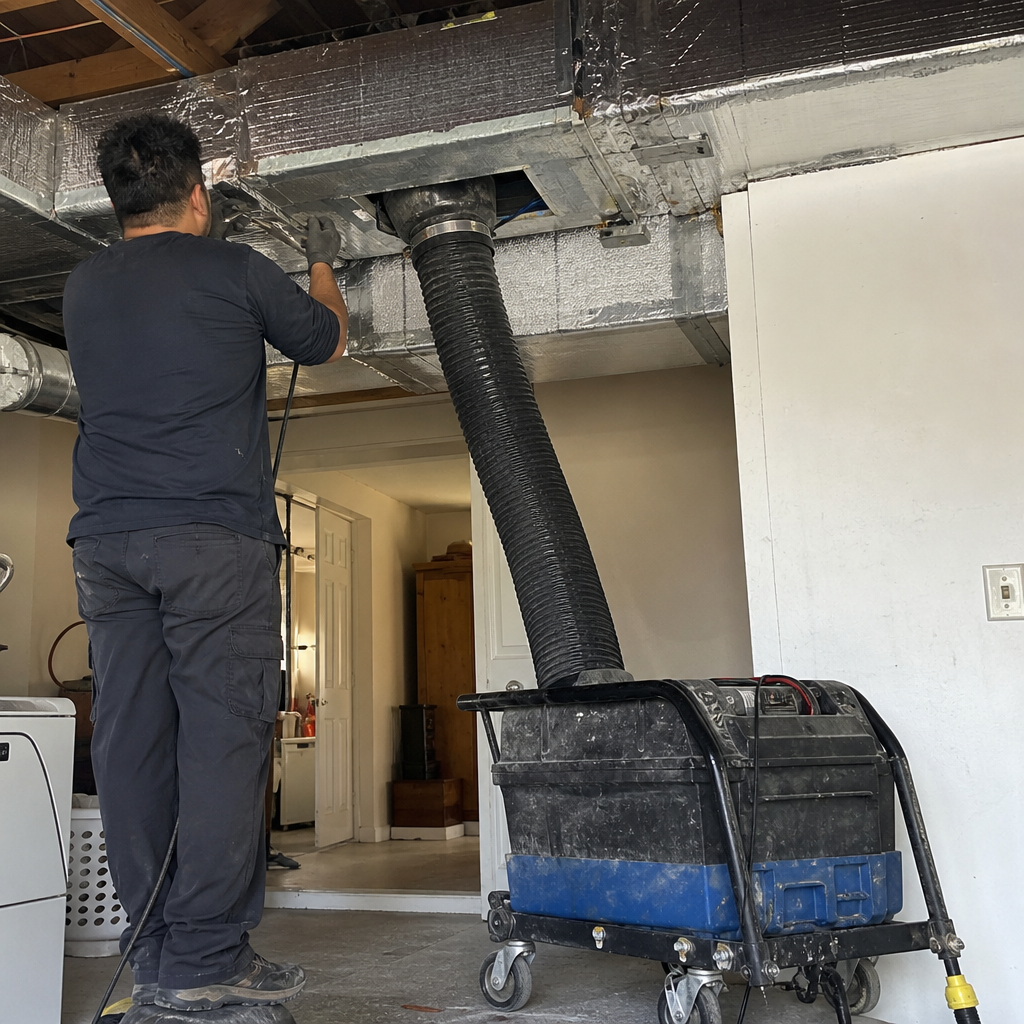
But the efficiency story goes beyond cleaning. This is where full-system care matters. A duct system with leaks, disconnected joints, or damaged sections loses conditioned air into attics and crawl spaces. You’re paying to cool air that never reaches your living spaces. Our approach pairs cleaning with repair capability: we use professional-grade equipment from Rotobrush and Nikro to clean what’s there, and then we fix what’s broken. Same visit, same system, no second company needed. That’s the difference between a surface-level service and a system that actually runs efficiently.
If you have whole-home IAQ equipment from Honeywell or Aprilaire already installed, seasonal duct care matters even more. These systems work best when the ductwork they connect to is clean and properly sealed. Dirty ducts undermine the performance of the equipment you’ve already invested in.
Wildfire Smoke and Your Ducts: When Cleaning Becomes Urgent
Wildfire smoke is no longer a rare event in Southern California. It’s a recurring seasonal pattern, and Orange homes are regularly exposed even when fires burn far away. Smoke particulate behaves differently from normal household dust, and it creates a specific case for duct cleaning.
Smoke particulate is extraordinarily fine. Much of it falls into the PM2.5 category, meaning particles smaller than 2.5 microns. These particles stay suspended in air for long periods, travel long distances, and penetrate homes through gaps, vents, and even closed windows. Once inside, they get pulled into return vents and settle throughout the duct system.
What makes smoke residue different from regular dust is the way it clings and the way it smells. Smoke particles carry volatile organic compounds that give off odor long after the visible smoke is gone. If you can smell smoke inside your home days after the skies have cleared, that smell is coming from somewhere. Duct interiors are a common culprit, especially if the system ran during the smoke event.
Here’s the question to ask yourself after a significant smoke exposure: how long did the smoke sit over Orange, and did your HVAC run during that time? If the answers are “several days” and “yes,” your ducts should be evaluated. A cleaning shortly after the smoke clears removes the particulate before it has months to settle further into the system and continue off-gassing into your living spaces.
Our cleaning process uses Abatement Technologies HEPA-rated negative air equipment, which captures contaminants during the cleaning process rather than circulating them through the home. That distinction matters, especially after a smoke event. The last thing you want is a cleaning process that kicks loose smoke particulate and redistributes it through your living rooms. The right equipment contains it. The wrong equipment spreads it.
For Orange homeowners with dryer vents as a secondary concern, remember that dryer vent cleaning in Orange is a separate service that addresses one of the leading causes of residential fires. It’s a safety service, not just a comfort one, and it’s worth scheduling annually regardless of what else is happening with your HVAC.
Common Mistakes to Avoid
- Following a generic “spring and fall” cleaning schedule. This advice comes from climates with four real seasons. Orange’s climate demands timing around Santa Ana winds, marine layer humidity, and wildfire smoke, not calendar dates. A May cleaning and an October assessment serve this home’s actual needs better than any generic schedule.
- Using the cheapest filter you can find indefinitely. Standard fiberglass filters catch large particles but let fine dust, pollen, and smoke particulate pass through into your ducts. During Santa Ana season and wildfire smoke events, a higher-MERV filter is worth the cost. Just verify your system can handle the airflow restriction first.
- Ignoring duct condition during cleaning. Clean ducts with leaks, gaps, or damaged flex liner still underperform. If you’re paying for cleaning, make sure the company can also identify and repair physical damage. Otherwise you’re cleaning a system that will be dirty again quickly.
- Waiting until you can smell a problem. By the time ducts produce a noticeable odor, contamination is significant. Seasonal maintenance prevents problems rather than reacting to them. The musty smell that appears in July probably started forming in May, during marine layer season.
- Assuming wildfire smoke only matters if you can see it. PM2.5 particles are invisible. Your home can be exposed to meaningful smoke particulate even when the sky looks clear. After any regional fire event that affects Orange, check filters and consider whether your system needs assessment.
- Treating dryer vents and air ducts as the same service. They’re separate systems with separate maintenance needs. Dryer vents need annual cleaning to prevent fire risk. Air ducts need seasonal attention around Orange’s climate patterns. Assuming one contractor visit covers both leads to neglected safety issues.
When to Call a Professional
Some duct maintenance tasks are homeowner-friendly: changing filters, checking vent grilles, noting musty odors. Others require professional equipment and expertise. Call a professional when you see disconnected duct joints in an accessible attic or crawl space, when a visual inspection shows significant dust accumulation inside supply registers, when you smell musty or smoky odors that persist after filter changes, when cooling is noticeably uneven between rooms despite clean filters and open vents, or when any family member experiences respiratory symptoms that improve away from home.
If you’ve just experienced a significant wildfire smoke event, or if you’ve lived in your Orange home for three or more years without a duct inspection, a professional assessment is warranted. Crisp Duct Cleaning offers free estimates in Orange. Call (833) 593-4428 to schedule an inspection and get a clear picture of what’s happening inside your duct system.
Frequently Asked Questions
Most Orange homes benefit from duct cleaning every 3 to 5 years, but homes with pets, recent renovations, or smoke exposure may need it more frequently. The timing matters as much as the interval: schedule cleaning for May before summer load begins, or October after wildfire season and summer accumulation. Call (833) 593-4428 for a free assessment specific to your home.
Price differences usually reflect equipment and scope. Companies using consumer-grade blowers or “negative air” machines that don’t actually contain debris can clean for less, but the results are inconsistent. Professional-grade systems like Rotobrush and Nikro with HEPA-rated containment cost more to operate but deliver measurably cleaner results. A quote that seems too low usually means a surface-level service. Call (833) 593-4428 for an honest assessment of what your system actually needs.
Ask for before-and-after photos of the duct interiors. A legitimate company using proper inspection cameras can show you exactly what was inside your ducts before cleaning and what they look like afterward. If a company can’t provide this, ask why. At Crisp Duct Cleaning, visual verification is standard practice.
Yes. Wildfire smoke contains fine particulate that penetrates homes and settles inside duct systems, especially when HVAC runs during smoke events. Even if smoke never entered your home directly, particles find their way in through return vents and envelope gaps. Cleaning after significant smoke exposure removes that particulate rather than leaving it to circulate through your home for months.
Yes. Dust and debris inside ducts restrict airflow, forcing your AC to run longer to reach target temperatures. With Orange’s cooling season running from May through October, that inefficiency compounds across hundreds of operating hours. Clean ducts move air more freely, which reduces run times and lowers energy costs.
For most homes, yes. October follows five months of continuous AC operation, the late-summer wildfire smoke season, and the start of Santa Ana winds. Cleaning in October removes a year’s worth of accumulated contamination at its peak concentration. Spring cleaning addresses only winter dust, which is typically less significant in Orange’s mild winters. Call (833) 593-4428 to schedule your October assessment before the holiday season.
The Bottom Line
Orange doesn’t have four seasons, but it does have an HVAC calendar, and that calendar has four distinct stress periods. Marine layer humidity turns spring dust into sticky residue. Summer heat forces continuous system operation for five months. Wildfire smoke deposits fine particulate deep in duct runs. Santa Ana winds drive dust through every opening in your home. A homeowner who understands this rhythm can schedule maintenance at the right moments: clean before the summer load in May, assess after the wildfire season in October, and monitor filters during Santa Ana events. The result is a system that runs more efficiently, circulates cleaner air, and costs less to operate through the months that matter most. That’s the difference between seasonal maintenance done on someone else’s schedule and seasonal care built for this city.
Written by the team at Crisp Duct Cleaning, serving Orange since 2012.