
Last updated November 3, 2026
Whole-system duct and dryer vent check with before-and-after photos - you see exactly what came out of your vents
That "$99 whole-house special" is a bait ad - the real number appears once they are in your hallway, or the "clean" is a shop-vac at the register. We photograph the inside of your ducts before and after instead.
Choosing the Right Air Duct Cleaning Brand: A Buyer’s Guide for Orange
Most homeowners hire duct cleaners without asking what equipment they use. That is like hiring a surgeon without asking what tools are in the operating room. In duct cleaning, the machine determines the outcome more than the technician’s effort does. A technician with a consumer shop vac and basic brushes can work hard all day and still leave most of the debris inside your ductwork. A technician with a Rotobrush system and a Nikro negative air machine removes what others cannot reach. In Orange, where homes range from 1950s ranch houses to newer two-story builds with multi-zone HVAC systems, the right equipment matters even more. Our Complete Air Duct Cleaning Guide for Orange Homeowners will teach you how to evaluate a duct cleaning company by its equipment, not its marketing.
Styles & brands we work with
- Whole-home duct cleaning
- Dryer vent cleaning
- Camera inspection
- Sanitizing & deodorizing
Quick Answer
The right Air Duct Cleaning services brand for your Orange home depends on your duct condition, home size, and whether you have specific contamination issues. Look for a contractor who uses rotary agitation equipment like Rotobrush for contact cleaning, Nikro negative air machines for true containment, and Abatement Technologies HEPA filtration when mold, smoke, or fine particulate is involved. A contractor who carries multiple equipment lines can handle more conditions than a single-method operator. Ask for specific model numbers, CFM ratings, and filter classifications before you book.
Table of Contents
- Why the Equipment Brand Matters More Than the Company Name
- Rotobrush Systems: Rotary Contact Agitation and Why It Works
- Nikro Negative Air Machines: The CFM Ratings That Actually Matter
- Abatement Technologies: Filtration for the Hard Cases
- Questions to Ask a Duct Cleaning Contractor About Their Equipment
- How Honeywell and Aprilaire Systems Change the Duct Cleaning Conversation
- Why a Contractor Carrying Multiple Equipment Lines Handles More Conditions
- Common Mistakes to Avoid
- When to Call a Professional
- Frequently Asked Questions
- The Bottom Line
Why the Equipment Brand Matters More Than the Company Name
A duct cleaning company’s name tells you nothing about what will happen inside your home. The equipment they load onto the truck tells you everything. Every major equipment brand in this industry is designed for a specific job condition. Some are built for contact agitation. Some are built for air movement and containment. Some are built for filtration under hazardous conditions. A serious contractor in Orange knows which tool fits which job and brings the right one.
The duct cleaning industry has an equipment problem. Many companies that advertise “professional air duct cleaning” are running consumer-grade equipment or improvised setups that cannot create the airflow needed to transport debris out of a duct system. The National Air Duct Cleaners Association recommends equipment that can produce sufficient negative pressure to extract loosened debris, but NAADCA membership is not required to operate in California. That means the burden of verification falls on you, the homeowner.
In Orange specifically, the housing stock works against cheap equipment. Many homes in the Old Towne Orange historic district were built before forced-air systems became standard, and ductwork has been retrofitted into attics and crawl spaces with long, angular runs. Newer developments around Orange Park Acres and Santiago Hills have larger homes with multiple HVAC zones. Long duct runs and multiple zones require equipment with higher CFM (cubic feet per minute) ratings to maintain airflow over distance. A small portable unit simply cannot pull debris through a forty-foot run with two bends and a reducer.
When we evaluate a home in Orange, the first question is condition, not price. The second question is access. The third question is what equipment we will bring. Those three questions drive the entire job. You should expect the same level of specificity from any contractor you call.
- Rotary brush systems physically scrub the duct walls. They remove caked-on dust, pet hair, and construction debris that vacuum-only methods leave behind.
- Negative air machines create a vacuum inside the duct system, pulling loosened debris toward a central collection point instead of pushing it into your living space.
- HEPA-filtered systems capture particles down to 0.3 microns, which matters when you are dealing with allergens, mold spores, or fine construction dust.
- Compressed air systems with proper containment are used for specific duct types and materials where brush agitation is not appropriate.
Visit our Crisp Duct Cleaning home page to see how we apply this equipment approach to every job.
Rotobrush Systems: Rotary Contact Agitation and Why It Works
Rotobrush is one of the most recognized names in professional duct cleaning, and for good reason. The Rotobrush system uses a motorized brush head attached to a flexible shaft that spins at high speed while a simultaneous vacuum extracts debris as it is loosened. That combination of rotary contact agitation and same-time extraction is what distinguishes it from a vacuum-only method.
A vacuum-only approach relies on negative air pressure alone to pull dust off the duct walls. That works for loose, light debris. It does not work for what we typically find in Orange homes: years of compacted dust, pet dander, hair, and in some cases, construction debris from a renovation that was never cleaned out of the system. Debris that has been sitting in a duct for five or ten years becomes adhered to the surface. Vacuum pressure alone will not break that bond. A rotary brush will.
There are conditions where a Rotobrush is the only appropriate tool. If a homeowner in the Villa Park area renovates a kitchen and drywall dust enters the return ducts, that dust will settle and compact. A Rotobrush head physically dislodges it. If a home has had pets for a decade and fur has accumulated around the register boots, brush agitation removes what suction alone cannot. If a duct system has not been cleaned in eight to ten years, a Rotary brush is non-negotiable for a complete result.
There is a nuance that most guides skip. The Rotobrush is not the right tool for every duct condition. Certain duct materials, including some older flexible duct types and specific lined ducts, require a gentler approach. A technician who knows the Rotobrush system also knows its limits. The tool matters, but judgment matters more.
What to Ask About Rotobrush
- Do you run a Rotobrush system with simultaneous vacuum extraction, or do you brush and vacuum in separate passes? Simultaneous extraction is the standard for professional-grade work.
- What brush head sizes do you carry? Different duct dimensions require different head diameters. A contractor with only one head size cannot properly clean all the runs in a typical home.
- Do you follow bi-directional cleaning protocols? Rotobrush systems are designed to clean in both directions, which matters for runs that cannot be accessed from the register only.
If you want a complete Air Duct Cleaning in Orange, the equipment type should be one of your first questions.
Nikro Negative Air Machines: The CFM Ratings That Actually Matter
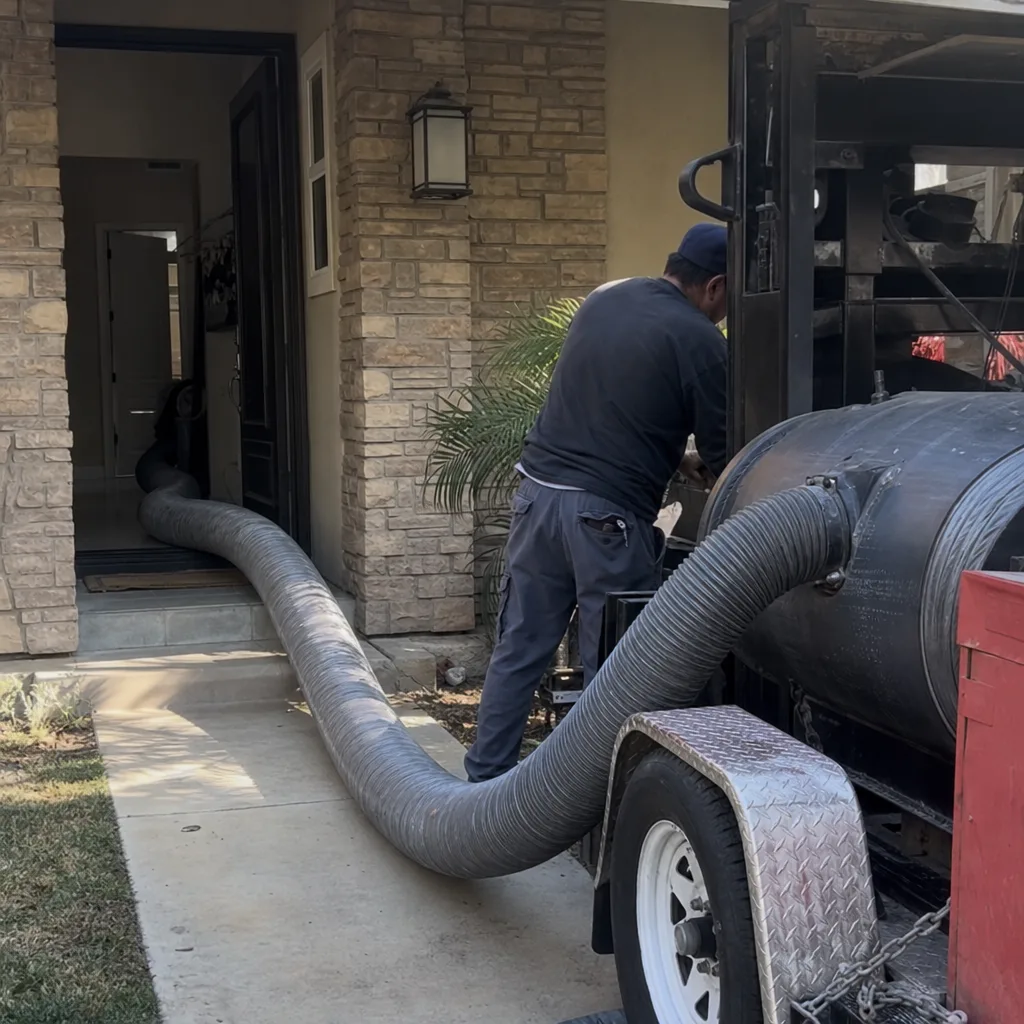
Nikro builds industrial-grade negative air machines and portable HEPA filtration units. In the duct cleaning industry, a negative air machine creates a vacuum on the duct system by connecting a powerful fan and filter assembly to the main trunk line or plenum. The machine pulls air through the ductwork at a high rate of speed, which carries loosened debris out of the system and into the machine’s filtration chamber.
The specification that matters most on a negative air machine is CFM, or cubic feet per minute. This number tells you how much air the machine moves. For a typical single-family home in Orange, you want a machine rated at 2,000 CFM or higher. Smaller units rated at 500 to 1,000 CFM simply cannot maintain enough airflow velocity through long runs to transport debris. When we clean a larger two-story home in Orange Park Acres with multiple zones and runs exceeding 40 feet, the CFM rating is the difference between a clean system and a partially cleaned one.
Here is why CFM matters in a way most homeowners never hear. Air moving through a duct loses velocity due to friction against the duct walls. The longer the run, the more velocity is lost. The more bends and transitions, the more velocity is lost. A machine rated at 2,000 CFM in ideal conditions may only deliver a fraction of that at the end of a 50-foot run with three elbows. Starting with an industrial CFM rating gives you headroom. Starting with an undersized unit means debris accumulates in exactly the places that are hardest to reach.
Nikro machines also offer staged filtration. A primary filter captures large particles, a secondary filter captures medium particles, and a HEPA filter captures particles down to 0.3 microns at 99.97% efficiency. That filtration cascade matters because it means what goes into the machine stays in the machine. It does not get exhausted back into your home.
For homeowners interested in Dryer Vent Cleaning in Orange, the same logic applies. Lint accumulation in dryer vents is a fire hazard, and the extraction equipment must be capable of pulling compacted lint from a vent run that may extend 20 to 30 feet or more.
Abatement Technologies: Filtration for the Hard Cases
Abatement Technologies is not a name most homeowners know. In the IAQ and remediation industry, it is one of the most respected brands in HEPA filtration and negative air containment. Their equipment is designed for situations where standard cleaning is not enough: mold remediation, asbestos abatement, smoke damage, and hazardous particle scenarios.
In a routine duct cleaning, a Rotobrush system and a Nikro negative air machine handle the job. But some homes in Orange have conditions that require a different level of containment. A homeowner who has discovered mold growth in the duct system needs more than brushing and vacuuming. A family dealing with smoke residue after a kitchen fire needs particulate capture at a level that prevents cross-contamination of other rooms. A home with a compromised immune occupant needs the highest possible filtration standard.
Abatement Technologies units are designed with true HEPA filtration and are built to run continuously under demanding conditions. The key difference is containment. A proper containment setup uses negative pressure to ensure that air flows from clean areas toward the contaminated area, and all air leaving the work zone passes through HEPA filtration. That is a fundamentally different process than a basic cleaning pass.
There is a practical point for Orange homeowners. The region’s dry climate means fine particulate stays airborne longer than it does in humid environments. When dust is disturbed during cleaning, it can remain suspended and redistribute through the home if containment is not adequate. HEPA-rated equipment from Abatement Technologies addresses that risk.
When Abatement-Grade Filtration Is Appropriate
- Visible mold growth inside ductwork or around supply registers
- Smoke damage or heavy soot accumulation from a fire
- Renovation dust containing unknown compounds from older building materials
- Households with residents who have severe respiratory conditions or immune compromise
- Duct systems that have not been cleaned in decades and contain unknown contaminants
Questions to Ask a Duct Cleaning Contractor About Their Equipment
Here is the practical core of this guide. When you call a duct cleaning company in Orange, the conversation should go beyond price. The answers to these questions will tell you more about what will happen in your home than any review or website.
Step 1: Ask What Brand of Equipment They Use
Listen for specific brand names. Rotobrush, Nikro, Abatement Technologies, and similar industry names indicate a contractor who has invested in professional-grade tools. Vague answers like “we use professional equipment” or “industrial-strength vacuums” without a brand name are a red flag. If they cannot name their equipment, they likely do not have equipment worth naming.
Step 2: Ask What CFM Rating Their Negative Air Machine Produces
For a single-family home in Orange, the minimum to accept is around 2,000 CFM. Anything less is likely inadequate for typical duct runs. Some contractors run portable units rated at 500 to 800 CFM. That is appropriate for small apartments or very short duct runs. It is not appropriate for a typical Orange home with 20 to 50 feet of duct per run.
Step 3: Ask What Filtration Standard Their Equipment Meets
The answer should include HEPA or 99.97% efficiency at 0.3 microns. If they cannot tell you the filtration rating of their collection equipment, assume the air being exhausted from the machine is not being filtered to a meaningful standard. That means contaminants captured from your ducts may be recirculated into your home.
Step 4: Ask If They Offer Duct Repair
This is where equipment and capability overlap. A contractor who cleans ducts but cannot repair them will leave damaged ductwork in place after a cleaning. If the technician finds a disconnected run, a crushed section, or deteriorated insulation during the cleaning, what happens next? A full-system approach means Air Duct Repair in Orange is available the same day, not scheduled weeks later with a different company.
Step 5: Ask What Happens If Something Is Found During the Cleaning
This question reveals whether you are dealing with a cleaning-only operator or a full-system specialist. The answer you want is some version of: “We diagnose it, show it to you, and fix it if repair is appropriate.” The answer you do not want is: “We clean and leave.” Ductwork that is disconnected, crushed, or leaking defeats the purpose of cleaning.
How Honeywell and Aprilaire Systems Change the Duct Cleaning Conversation
Many Orange homes have IAQ equipment installed that most duct cleaners ignore. Honeywell and Aprilaire are two of the most common brands of whole-home air quality equipment: media air cleaners, electronic air cleaners, humidifiers, dehumidifiers, and UV systems. This equipment is installed in the duct system and interacts directly with the airflow that passes through it.
The relevance to duct cleaning is straightforward. If your home has an Aprilaire media filter cabinet installed at the air handler, that cabinet is a collection point for particulate. During a duct cleaning, it needs to be opened, inspected, and the filter checked. If your home has a Honeywell electronic air cleaner, the collection cells need to be cleaned according to manufacturer specifications. A duct cleaning contractor who is not familiar with this equipment will clean around it and leave a compromised component in the system.
There is another layer. IAQ equipment like Aprilaire dehumidifiers and Honeywell ventilation systems are designed around specific airflow assumptions. When ducts are heavily loaded with debris, the airflow resistance increases, which forces the IAQ equipment to work harder and perform below specifications. Cleaning the ducts restores the airflow conditions the equipment was designed for. A technician who understands the Honeywell or Aprilaire ecosystem can evaluate the whole system, not just the duct surfaces.
When we clean a home in Orange that has IAQ equipment installed, the service includes an inspection of that equipment as it relates to the duct system. That is not an upsell exercise. It is recognition that ducts are not an isolated component. They are part of a whole-home air system, and the pieces have to work together.
Why a Contractor Carrying Multiple Equipment Lines Handles More Conditions
No single piece of equipment handles every duct condition. A rotary brush system is excellent at contact agitation but is not a containment tool. A negative air machine creates the airflow for extraction but does not agitate. HEPA filtration captures fine particulate but does not dislodge adhered debris. A contractor who carries one tool can do one thing. A contractor who carries multiple equipment lines can match the tool to the job.
This is the operational reality that most guides & resources do not explain. When a duct cleaning company invests in Rotobrush, Nikro, and Abatement Technologies equipment, they have made a capital commitment in the tens of thousands of dollars. That commitment signals something about how seriously they take the work. It also means they have the training to operate multiple systems correctly. A company that shows up with a single portable unit and a set of basic brushes has not made that commitment and cannot offer the same capability.
The practical consequence for an Orange homeowner is diagnostic. Different duct conditions in the same home may require different tools. A main trunk line with years of compacted dust requires rotary agitation. A long branch run requires high CFM extraction. A return duct with construction debris requires both. When the contractor has multiple systems on the truck, the technician can adapt to what they find rather than forcing a single method onto every condition.
This is also where repair capability matters. Duct systems are mechanical. They develop problems: separated joints, crushed sections, deteriorated flex duct, leaking connections. During a cleaning, these problems become visible. A contractor who only cleans writes up a report and leaves. A contractor with repair capability opens the problem, diagnoses it, and fixes it in the same visit. That is the difference between a service and a solution.
Common Mistakes to Avoid
- Hiring on price alone without asking about equipment. The lowest bid usually reflects the cheapest equipment. In duct cleaning, cheap equipment means incomplete extraction and debris left behind in the runs you cannot see.
- Assuming all “professional” equipment is the same. A 500 CFM portable unit and a 2,000 CFM Nikro negative air machine are not comparable. CFM rating, filtration standard, and agitation method are the relevant metrics.
- Accepting a quote without a pre-inspection. A serious contractor in Orange wants to see the duct system before quoting. Duct access, contamination level, and system layout determine the scope. A quote given sight unseen is a guess.
- Ignoring the repair question. If the contractor cannot repair what they find during cleaning, you will be calling a second company. Ask before you book, not after the technician finds a separated run in your attic.
- Focusing on vent cleaning when the ducts are the problem. Register and grille cleaning is cosmetic. The duct runs themselves hold the accumulation. Make sure the quote covers the full system, not just the visible openings.
- Skipping the dryer vent. Dryer vents are a leading cause of residential fires. A company that offers Dryer Vent Cleaning in Orange as a standalone service is applying a safety-first approach to the home, not just a comfort service.
- Not asking about filtration standards. If the collection equipment does not have HEPA-rated filtration, the cleaning process can redistribute contaminants from the ducts into your living space. Captured, not circulated, is the standard to insist on.
When to Call a Professional
Call a professional duct cleaning company when you can see dust buildup at the registers, when your allergy symptoms worsen at home, or when you have completed a renovation and know construction dust entered the system. Call if you have never had the ducts cleaned and have owned the home for five years or more. Call if you smell musty odors when the HVAC system runs. And call if you find evidence of pests, moisture, or mold in the duct system. These are not DIY conditions. The tools required for proper extraction are not available at hardware stores, and the danger of pushing contaminants deeper into a system with improvised equipment is real.
Crisp Duct Cleaning offers free estimates in Orange, California. Call (833) 593-4428 to speak with a technician about your system.
Frequently Asked Questions
Air duct cleaning in Orange typically costs between $350 and $700 for a full single-family home system, depending on home size, number of zones, and contamination level. Larger homes near Orange Park Acres with multiple HVAC zones run higher. A serious quote requires a pre-inspection, and any price given without one is an estimate, not a binding quote. Call (833) 593-4428 for a free estimate based on your actual system.
Cheaper quotes usually mean cheaper equipment and a narrower scope. A company running a 500 CFM portable unit and basic brushes can offer a low price because their costs are low, but they cannot extract debris from long runs or multiple zones. The difference is not profit margin. It is capability.
Ask for before-and-after visual documentation of the duct interior. A professional-grade service captures images of the duct surfaces before and after cleaning so you can see the result. You can also request an inspection of specific runs you want verified. If a company refuses to show you what was done, that is an answer in itself.
Every three to five years is the industry standard for most Orange homes, though homes with pets, allergy sufferers, or recent renovations may need more frequent service. The real answer is conditional: clean when the ducts are dirty, not on a fixed calendar. A visual inspection tells you when the time has come.
The cleaning equipment requirements are the same, but the technician’s knowledge requirement changes. Your duct cleaning contractor should know how to inspect and service the IAQ components installed in your system. Honeywell and Aprilaire equipment interacts with duct airflow, and cleaning should account for those components rather than working around them.
It can, with a caveat. If your ducts are carrying years of accumulated dust, pollen, and dander, cleaning removes that reservoir and reduces the particulate load in your home. The caveat is that equipment quality determines the result. A cleaning that fails to extract the loosened debris can make things temporarily worse by disturbing material without removing it. Proper negative air containment is the difference.
The Bottom Line
The equipment a duct cleaning company uses is the most reliable indicator of what will happen inside your home. In Orange, where housing stock varies from historic retrofits to large multi-zone builds, the right equipment is not optional. Look for rotary agitation systems like Rotobrush for contact cleaning, high-CFM negative air machines from Nikro for proper extraction, and HEPA-grade filtration from Abatement Technologies when conditions demand containment. Ask specific questions about brand names, CFM ratings, and filtration standards. And choose a contractor who can repair what they find, not just clean and leave. The machine determines the outcome. The questions you ask determine the machine. For a deeper dive, see our Complete Guide to Air Duct Cleaning in Orange.
Written by the team at Crisp Duct Cleaning, serving Orange since 2012.