
Last updated November 2, 2026
Whole-system duct and dryer vent check with before-and-after photos - you see exactly what came out of your vents
That "$99 whole-house special" is a bait ad - the real number appears once they are in your hallway, or the "clean" is a shop-vac at the register. We photograph the inside of your ducts before and after instead.
DIY vs Professional Air Duct Cleaning: The Orange Homeowner’s Decision Guide
A standard Shop-Vac generates roughly 100 CFM of suction. A professional negative air machine like the Nikro generates 2,000+ CFM. That’s not a small difference. It’s the difference between moving surface debris around and actually extracting it from a sealed duct system. This guide explains the physics behind duct cleaning, what an Orange homeowner can realistically do themselves, and where the DIY approach quietly fails in ways that cost more than the service ever would.
Styles & brands we work with
- Whole-home duct cleaning
- Dryer vent cleaning
- Camera inspection
- Sanitizing & deodorizing
Quick Answer
For anything beyond wiping vent covers and swapping filters, our Air Duct Cleaning services are the only method that generates the negative air pressure needed to extract debris from sealed ductwork. Consumer equipment doesn’t have the airflow to do the job. In Orange, where homeowners run AC for most of the year, duct systems accumulate fine dust that settles deep in return plenums and supply trunks. A DIY approach removes what you can see. A professional system removes what you can’t.
Table of Contents
- The CFM Problem: Why Airflow Beats Effort
- What Homeowners Can Legitimately Do Themselves
- When DIY Is Actively Counterproductive
- Consumer Equipment vs Professional Negative Air Systems
- How to Use a DIY Inspection to Prepare for a Professional Visit
- How Orange’s Climate and Housing Stock Affects Duct Contamination
- The Real Cost Comparison: Why Renting Still Falls Short
- Common Mistakes to Avoid
- When to Call a Professional
- Frequently Asked Questions
- The Bottom Line
The CFM Problem: Why Airflow Beats Effort
Duct cleaning is not scrubbing. You are not wiping dirt off a surface. You are extracting particulate matter that has settled inside a sealed airway, often in sections you cannot reach by hand. The only tool that does that successfully is airflow. Specifically, high-volume airflow measured in cubic feet per minute, or CFM.
Here’s the core issue. A typical consumer Shop-Vac, even a strong one, moves about 100 to 150 CFM. It creates localized suction at the end of a hose. That’s fine for pulling dust out of a register boot within a foot of the opening. It does nothing for the 30 feet of trunk line behind it. The dust in that trunk line doesn’t care how hard you try. It only responds to the volume of air moving past it.
A professional negative air machine, like those built by Nikro and used in commercial and residential duct cleaning across Orange, moves 2,000 CFM or more. When connected to a sealed duct system, it puts the entire system under negative pressure. Debris that was resting in the return drop, the supply plenum, and the far end of a branch line gets pulled toward a single extraction point. The air moves fast enough to dislodge and carry particles through the system and into a HEPA-filtered collection unit.
Our techs see this difference on almost every job with Air Duct Cleaning in Orange. A homeowner will have spent a weekend with a shop vac and vent brushes, then call us because the visible dust came back within weeks. What happened is predictable. The DIY work disturbed debris in the duct interior without removing it. Loose particles that were previously adhered to duct walls were knocked into the airstream by the brush, then redistributed throughout the system once the blower turned on. The homeowner effectively aerosolized their own duct contamination.
The message here isn’t about effort. An Orange homeowner can spend a full Saturday on their hands and knees with a brush kit and a box-store vacuum. The physics doesn’t care about the effort. Below a certain airflow threshold, no amount of scrubbing extracts debris from a sealed system. You are rearranging dust, not removing it.
What Homeowners Can Legitimately Do Themselves
That doesn’t mean an Orange homeowner should do nothing. There are real maintenance tasks that belong to the occupant, not the technician. The line between the two is simple: you can maintain access points and visible surfaces. You cannot clean the inside of the duct system. Here’s what falls on the homeowner side of that line.
Register and Grille Cleaning
Supply registers and return grilles collect dust on the visible face and the back side of the louvers. Removing them, washing them with warm water and mild dish soap, and letting them dry completely before reinstallation is a legitimate maintenance task. Do this quarterly in Orange homes, especially during the Santa Ana wind season when airborne dust loads spike.
Filter Replacement and Upgrades
The HVAC filter is the first line of defense for the entire system. Orange homeowners who run AC six to eight months a year should check filters every 30 days during peak cooling months and replace them when visibly loaded. A pleated MERV 8 filter is a reasonable baseline for most systems. A MERV 11 or MERV 13 filter captures more fine particulate but increases static pressure. Before upgrading, verify your blower can handle the additional resistance. A filter upgrade that starves the blower of air shortens motor life and reduces system efficiency.
Visible Flex Duct Inspection
In attics and crawlspaces with accessible flex duct runs, a homeowner can visually inspect for obvious problems: collapsed sections, kinks, disconnected joints, torn outer jackets, and sagging runs. None of these need a technician to spot. All of them need a technician to fix properly. Document what you find, photograph it, and report it during your next professional service visit. A 15-minute crawlspace inspection can save a service hour later.
Dryer Vent Lint Removal at the Wall Connection
Disconnect the dryer from the wall vent once or twice a year and remove the lint that collects at the connection point. Use a vacuum and a flexible brush to clear the first few feet of the vent run. This is surface-level maintenance, not a substitute for full Dryer Vent Cleaning in Orange, but it reduces fire risk between professional cleanings.
Return Filter Grille Cleaning
If your system uses a central return with a filter grille, the grille itself and the filter frame collect dust. Clean both with a damp cloth during each filter change. This is access maintenance, not duct cleaning. It keeps the visible portion of the system clean and makes filter replacement more effective.
When DIY Is Actively Counterproductive
There are scenarios where a DIY attempt doesn’t just fail. It makes the problem worse. An Orange homeowner who doesn’t recognize these situations can turn a $400 cleaning into a $2,000 remediation.
Mold-Suspected Systems
If you see visible mold growth on duct interiors, register faces, or around the air handler, do not disturb it. Brushing or vacuuming mold disperses spores through the entire home. Mold inside a duct system requires evaluation by a qualified professional who can determine the extent of contamination and whether cleaning or replacement is appropriate. Disturbing the growth first contaminates surfaces that were previously unaffected. This is not a scenario where a homeowner should experiment.
Post-Renovation Debris
Orange homeowners who’ve had drywall work, flooring replacement, or kitchen remodels done frequently find construction dust throughout the HVAC system. Drywall dust is extremely fine, abrasive, and easily aerosolized. A shop vac without HEPA filtration exhausts a significant portion of what it collects back into the room. Attempting to clean post-renovation ducts with consumer equipment takes dust that had settled in the ducts and launches it through the living space. Professional extraction with HEPA-rated negative air equipment captures the debris instead of circulating it.
Pest Contamination
Rodent droppings, insect debris, and nesting materials in ducts are hazardous waste, not routine dust. Disturbing these materials without proper containment and personal protective equipment exposes occupants to pathogens. If you hear activity in ductwork or find droppings near registers, seal off the affected rooms, shut down the HVAC system to prevent further distribution, and call a professional. This is a health issue, not a maintenance issue.
Pre-1978 Homes with Potential ACM Wrap
Older Orange homes may have ductwork wrapped in material containing asbestos, particularly on metal duct joints. Disturbing this wrap with brushes or vacuums releases fibers. If your home was built before the late 1970s and you’re not certain what’s on your ducts, have a professional evaluate before any cleaning attempt. We see this occasionally in older Orange neighborhoods with original HVAC systems.
Consumer Equipment vs Professional Negative Air Systems
The equipment gap is not a matter of brand preference. It’s a matter of mechanical capability. Here’s what separates the tools.
Consumer Tools: What They Actually Do
- Shop vacuums: 100-150 CFM, localized suction. Good for wet spills and workshop debris. Not capable of pulling air through a sealed duct system.
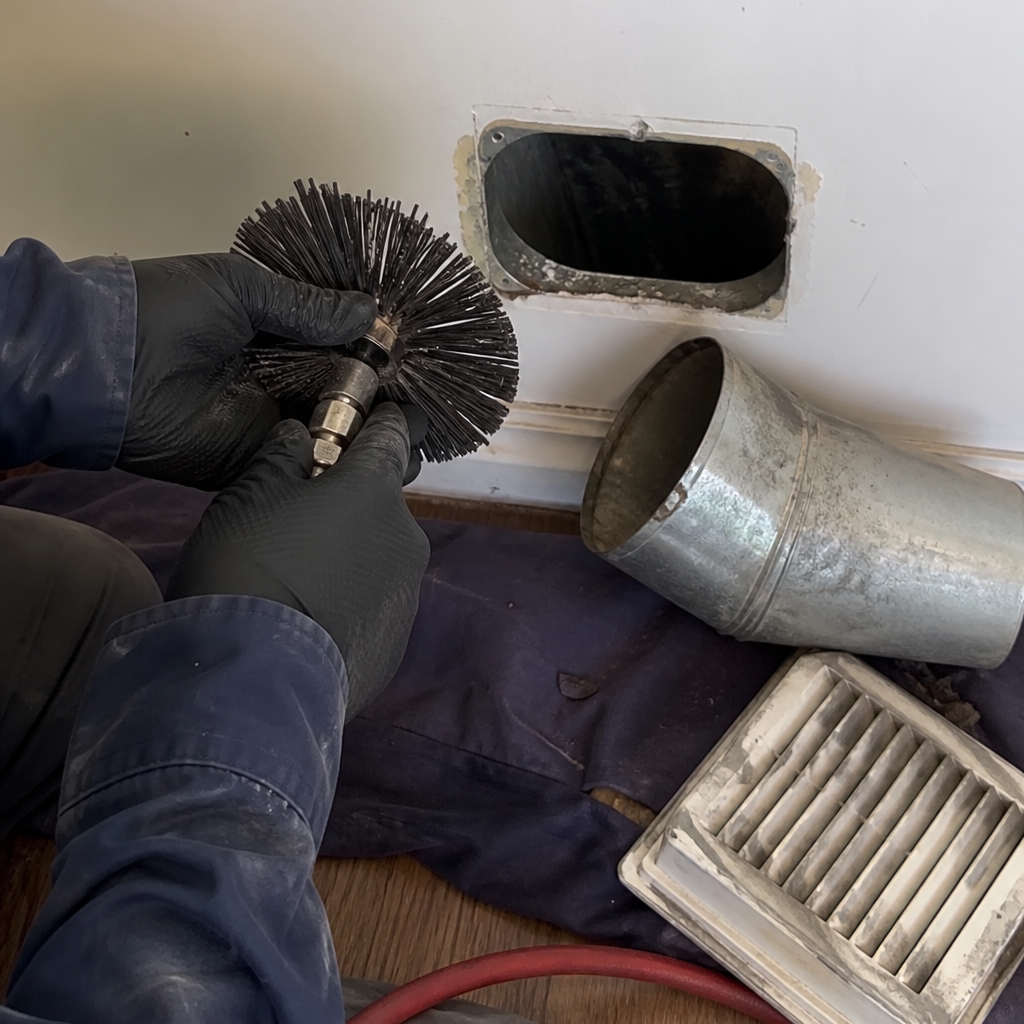
- Vent brush kits: Useful for register boots and the first foot of visible branch line. The brush dislodges particulate; the vacuum attached to it may or may not capture it. In practice, brushes often push debris deeper into the branch before the vacuum can reach it.
- Leaf blowers: These push air into one end of a duct. That’s problematic for several reasons. The blower is not filtered. It pressurizes the system rather than depressurizing it, which forces debris out through every gap, register, and seam in the ductwork. And it introduces whatever debris is in the blower’s intake air directly into the duct.
- Rented duct cleaning machines from hardware stores: These are closer to professional equipment in form but not in performance. Most rental units are smaller compressors with rotary brushes and a vacuum attachment. They generate 300-500 CFM. That’s better than a shop vac, but still below the airflow required for full-system extraction. Rental units also see zero maintenance between customers. Filters are often clogged from the previous renter, further reducing airflow.
Professional Equipment: What It Actually Does
- Rotobrush systems: These combine a rotary agitation brush with a high-volume vacuum in a single tool. The brush mechanically dislodges debris from duct walls while the vacuum extracts it simultaneously. Rotobrush equipment is purpose-built for duct cleaning. It is not adapted from another application.
- Nikro negative air machines: These units connect to the duct system and pull the entire system under negative pressure. Debris from all branch lines moves toward the extraction point. The machine filters the exhausted air through HEPA filtration before returning it to the space.
- Abatement Technologies HEPA-rated air scrubbers and negative air units: These capture and contain contaminants during the cleaning process. In scenarios involving mold, post-renovation dust, or pest debris, the containment matters as much as the cleaning. The air leaving the equipment is cleaner than the air entering it. Debris is captured, not circulated.
The distinction matters for an Orange homeowner because the visible result looks similar at first. After a DIY attempt, the register faces look clean. The first three feet of each branch line may look clean. The trunk line, the plenums, the return drop, and the air handler coil remain untouched. The system appears clean until the blower kicks on and redistributes the undisturbed debris.
How to Use a DIY Inspection to Prepare for a Professional Visit
The best use of a homeowner’s DIY energy is documentation. A thorough pre-service inspection saves time during the professional visit and ensures the technician addresses real problems rather than spending service minutes discovering them. Here’s the process we recommend to Orange homeowners before scheduling professional cleaning.
- Remove and photograph register faces. Take photos of the visible interior of each supply register and return grille. Note any visible dust accumulation, discoloration, or moisture staining. These photos give the technician a baseline and help prioritize which branch lines need the most attention.
- Inspect the filter and filter housing. Document the filter’s condition. If it’s collapsed, torn, or bypassed, photograph that too. A collapsed filter means unfiltered air was entering the system, which has implications for coil cleanliness and duct contamination.
- Check accessible flex duct in the attic or crawlspace. Look for kinked, sagging, or disconnected runs. Photograph anything abnormal. A disconnected run means conditioned air is being dumped into the attic, and the room it serves is being pressurized with whatever is in the attic air.
- Note the return air configuration. Identify where return air enters the system. If returns are located near the floor in rooms with pets, or if the return is in a hallway near the kitchen, note that. These configurations pull specific types of particulate into the system, and the technician should know.
- Document any symptoms. Write down what you’ve observed: rooms that stay dusty, allergy symptoms that worsen when the AC runs, musty smells from registers when the system starts. These symptom notes guide the technician’s diagnostic focus.
- Check the dryer vent exterior termination. Go outside, find the dryer vent hood, and check for lint buildup or a stuck flapper. If the flapper doesn’t open when the dryer runs, that’s a ventilation problem that affects both dryer efficiency and fire risk.
This documentation means the professional cleaning appointment starts productively. The technician verifies what you found, confirms the scope of the problem, and works through the cleaning rather than spending time on basic discovery. It also prepares you to ask informed questions about what the technician finds.
The same inspection logic applies to the other major components of the air system. We’ve seen Orange homeowners identify disconnected flex duct runs in the attic that explained why a bedroom never cooled properly. That’s diagnostic value that cost them nothing but 20 minutes with a flashlight and a phone camera.
How Orange’s Climate and Housing Stock Affects Duct Contamination
Orange, California has a specific combination of climate and housing characteristics that shapes how ducts get dirty and what cleaning them actually involves.
The climate is Mediterranean: warm, dry summers and mild, wet winters. Air conditioning runs heavily from June through October, sometimes longer. During those months, the HVAC system is the primary distributor of whatever is in the indoor environment. Orange’s position in the Santa Ana wind corridor means periodic wind events sweep fine dust and particulate across the region. That dust enters homes through windows, doors, and the general air exchange that occurs in any structure. Once inside, the HVAC system recirculates it.
Housing stock in Orange spans several eras. Homes built in the 1950s and 1960s in neighborhoods near Old Towne Orange often have original metal ductwork. Some of that ductwork is wrapped in insulation containing material that requires professional handling. Homes built in the 1980s and 1990s in areas like East Orange and the neighborhoods around Santiago Hills frequently use flex duct, which has its own failure modes: kinking, sagging, and jacket tears. Newer construction, including multi-family units near the Chapman Avenue corridor, typically uses a mix of flex duct and insulated metal trunk lines.
Each configuration has different contamination patterns. Metal duct systems collect dust in return drops and plenums, and they’re prone to rust if moisture has been present at any point. Flex duct systems collect debris at low points and at connection collars, and damaged jackets allow attic air, insulation particles, and whatever crawls through the attic to enter the ducts directly.
An Orange homeowner dealing with persistent dust, allergy symptoms that worsen with AC use, or visible debris around registers should understand that their home’s specific construction era and duct configuration shapes the problem. A 1960s home with original metal ducts and a 1995 home with flex duct have different failure modes and different cleaning requirements. The professional who shows up should be able to identify which situation they’re looking at and adapt the cleaning approach accordingly. At Crisp Duct Cleaning home, our techs are trained on both metal and flex systems and can diagnose configuration-specific problems during the service visit.
The Real Cost Comparison: Why Renting Still Falls Short
Orange homeowners asking about DIY duct cleaning are usually asking about cost, not technique. The thinking goes: a professional cleaning costs several hundred dollars. A rental costs less. A DIY attempt with tools I already own costs even less. Here’s why that math doesn’t hold up.
Professional Cleaning Cost
A professional air duct cleaning in Orange for a typical single-family home, including supply and return lines, plenums, and the air handler, typically runs from $350 to $550 depending on system size and contamination level. Homes with multiple systems, extensive flex duct runs, or significant contamination fall higher. It’s a real cost, and an Orange homeowner should treat it as an investment in system operation and indoor air quality.
DIY Cost
Start with a shop vac you already own. Add a vent brush kit, which runs $30 to $80 at a hardware store. Add a dryer vent brush kit, another $25 to $50. If you need a longer-reach brush system, add $75 to $150. The tools total somewhere between $100 and $250, depending on what you already own.
Now consider the value of your time. A thorough DIY attempt on a standard Orange home takes a full day. If the attempt fails to extract debris from the trunk lines and plenums, as it will with consumer equipment, you’ve spent a day and some amount of money to achieve a surface cleaning. The debris that matters is still in the system.
Rental Cost
Renting a duct cleaning machine from a hardware store or equipment rental yard in Orange typically runs $150 to $250 per day, plus the cost of any consumable filters or accessories. These units have limitations. The airflow is higher than a shop vac, but still well below professional negative air equipment. The machines see heavy use and inconsistent maintenance. Filters may not have been changed between rentals. And the homeowner operating the machine has no training in how to connect it to the duct system for maximum extraction, no training in identifying problem areas during cleaning, and no way to verify the result.
When you account for rental cost, tool purchase, time, and the high probability of incomplete extraction, the DIY path often approaches the cost of professional service while delivering a fraction of the result. That’s the math that surprises people. The DIY route isn’t free. It’s a low-cost attempt with a high failure rate.
What the Professional Brings Beyond Cleaning
The Air Duct Repair in Orange capability changes the value equation further. During professional cleaning, a technician can identify and repair specific problems: disconnected flex runs, damaged collars, torn jackets, poorly sealed joints. These are not things a homeowner or a rental machine can address. If the cleaning finds a disconnected run in the attic, the technician fixes it on site. That repair simultaneously improves system efficiency and stops the contamination source that made the ducts dirty in the first place.
That’s the difference between cleaning and fixing. A DIY attempt or a rental clean might remove visible debris from register openings. It won’t diagnose the disconnected flex line that’s been pulling attic air into the system. It won’t find the failed seal at the return plenum. It won’t identify the torn jacket on a crawlspace run. The professional service is diagnostic as well as extractive.
Common Mistakes to Avoid
- Using a leaf blower to “blow out” the ducts. Leaf blowers pressurize the system and force debris out through every gap, seam, and register. They also introduce unfiltered outdoor air into the ductwork. The result is a bigger mess than the one you started with.
- Aiming a shop vac at a register and calling it done. This cleans the visible opening. It doesn’t clean the branch line, trunk line, plenum, or return drop. The system still holds the debris that was causing the problem.
- Brushing register faces with a dry cloth. Dry wiping dusts the room. The particulate goes airborne and gets pulled right back into the return. Use a damp cloth or remove the register and wash it.
- Upgrading to a high-MERV filter without checking static pressure. A MERV 13 filter in a system not designed for it reduces airflow, stresses the blower, and shortens equipment life. Confirm with a technician before upgrading.
- Ignoring the dryer vent during a duct cleaning project. The dryer vent is part of the same airflow ecosystem. A blocked dryer vent is a fire hazard independent of the HVAC ducts. Orange homeowners should include dryer vent service in any comprehensive approach to home airflow.
- Attempting to clean mold-suspected ducts without professional evaluation. Disturbing mold before understanding the scope spreads spores and contaminates previously clean areas. This is the most expensive mistake a homeowner can make in this arena.
- Renting equipment without understanding system access points. Many Orange homes have inaccessible sections of ductwork. A homeowner with a rental machine and no understanding of the system layout will likely fail to connect the equipment properly, resulting in an incomplete clean and wasted rental fees.
When to Call a Professional
Call a professional when you see visible dust accumulation inside ductwork beyond the register opening. Call when you’ve done renovation work and the system has been running during construction. Call when allergy symptoms worsen when the AC runs. Call when you find mold, pest debris, or evidence of rodents in the ductwork. Call when the system has not been professionally cleaned in years, or when you don’t know if it ever has. Call when a visual inspection reveals disconnected flex runs, collapsed ducts, or torn insulation. In any of these scenarios, the problem is beyond consumer equipment capability and requires professional extraction, diagnosis, and repair. Crisp Duct Cleaning offers free estimates in Orange – call (833) 593-4428 for an honest assessment of your system.
Frequently Asked Questions
Professional air duct cleaning in Orange typically costs $350 to $550 for a standard single-family home with one HVAC system, depending on system size, configuration, and contamination level. Larger homes, multiple systems, and heavily contaminated ductwork run higher. Estimates should be free and should specify exactly what’s included: supply lines, return lines, plenums, air handler access, and whether dryer vent service is separate. Call (833) 593-4428 for an exact quote based on your home’s specifics.
Cheap duct cleaning quotes in the Orange market usually come from operators using low-CFM equipment, doing register-level cleaning rather than full-system extraction, or using a low introductory price to get a van in the driveway before upselling. A legitimate professional clean requires negative air equipment, HEPA filtration, trained technicians, and time. Those cost money. If a quote seems too low, ask what equipment they use, what CFM their extraction system generates, and what exactly the price covers.
Ask for before-and-after photos of the duct interior, not just register faces. A legitimate professional with rotary brush equipment or negative air setup can document the trunk lines, plenums, and branch runs with the same access points used during cleaning. These photos should show visible improvement. If a company cannot provide before-and-after documentation of the actual duct interior, be skeptical of what was actually cleaned.
Most Orange homes need professional duct cleaning every 3 to 5 years. Homes with pets, smokers, recent renovations, or occupants with respiratory conditions may need service more frequently. The interval depends on filter discipline, system condition, and local dust exposure. Santa Ana wind events increase dust loading in the Orange area, which can shorten the interval for some homes. After a professional cleaning with documentation, you’ll have a baseline to judge how quickly contamination rebuilds in your specific home.
A shop vac generating 100-150 CFM cannot generate the airflow required to extract debris from a sealed duct system. You can clean visible register faces, brush the first foot of branch lines, and maintain filters. The trunk lines, plenums, return drops, and air handler coil require negative air equipment generating 2,000+ CFM. Attempting the job with consumer equipment disturbs debris without extracting it, often redistributing it through the home when the system next runs.
No. The dryer vent is a separate exhaust run that terminates outside. It’s not connected to the HVAC ductwork. Cleaning it requires different equipment and access. However, the two services address the same core concern: airflow through your home’s ducted systems. A blocked dryer vent is the leading cause of appliance-related home fires. Orange homeowners should include Dryer Vent Cleaning in Orange as a standalone service, scheduled separately or alongside an HVAC duct cleaning appointment.
The Bottom Line
The DIY vs professional decision for air duct cleaning isn’t about effort, cost, or preference. It’s about airflow physics. Consumer equipment cannot generate the negative pressure required to extract debris from a sealed duct system. Homeowners can and should handle visible maintenance: register cleaning, filter replacement, flex duct inspection, and dryer vent lint removal. Full-system extraction, diagnosis, and repair require professional equipment and training. In Orange, where AC runs for most of the year and Santa Ana winds load homes with fine particulate, the condition of your ductwork affects indoor air quality daily. A professional cleaning with HEPA-rated negative air equipment, coupled with repair capability for whatever the cleaning uncovers, is the only approach that actually removes contamination rather than moving it around. For more guides & resources, visit our blog. For a free estimate and an honest assessment of your system, call (833) 593-4428.
Written by the team at Crisp Duct Cleaning, serving Orange since 2012.