
Last updated November 3, 2026
Whole-system duct and dryer vent check with before-and-after photos - you see exactly what came out of your vents
That "$99 whole-house special" is a bait ad - the real number appears once they are in your hallway, or the "clean" is a shop-vac at the register. We photograph the inside of your ducts before and after instead.
The Complete Air Duct Cleaning Guide for Orange Homeowners
The majority of Orange homes were built before 1995, which means millions of linear feet of aging flex duct that traps debris differently than rigid sheet metal. If you own one of these homes, the cleaning method matters more than you think. This guide explains how Orange’s housing stock, climate, and seasonal conditions affect what’s inside your ducts, how our Air Duct Cleaning services actually work, and how to know the job was done right. You’ll learn the difference between contact cleaning and vacuum-only systems, why the air handler matters as much as the branch runs, and what Orange homeowners should ask before hiring anyone.
Quick Answer
Air duct cleaning in Orange typically involves a professional-grade contact cleaning system like Rotobrush paired with negative-air containment from Abatement Technologies, and it costs between $450 and $1,200 depending on system size and accessibility. Most Orange homes built in the 1970s through 1990s have flex duct that requires mechanical agitation to dislodge debris, not just vacuum suction. A proper clean should include the supply and return ducts, air handler, coil cavity, and return plenum, and you should see before-and-after airflow measurements and camera verification.
Styles & brands we work with
- Whole-home duct cleaning
- Dryer vent cleaning
- Camera inspection
- Sanitizing & deodorizing
Table of Contents
- Why Orange Homes Have a Specific Duct Problem
- Contact Cleaning vs. Vacuum-Only: The Mechanical Difference
- What a Full-System Clean Actually Includes
- How Much Air Duct Cleaning Costs in Orange
- How to Verify the Job Was Done Right
- Orange-Specific Factors: Wind, Gas Appliances, and Slab Foundations
- How Often Do Orange Homes Really Need Duct Cleaning?
- How to Choose a Duct Cleaning Company in Orange
Why Orange Homes Have a Specific Duct Problem
Orange is a city shaped by postwar growth. Walk through neighborhoods like the tracts north of Chapman Avenue or the subdivisions near Villa Park, and you’ll see the same pattern: single-story ranch homes, two-story additions, and HVAC systems installed when the houses were built. The dominant construction era here runs from roughly 1965 through 1995. That matters because those homes almost universally use flex duct, the insulated, wire-reinforced tubing that connects supply and return registers to the main trunk lines.
Flex duct has a textured inner liner. Debris doesn’t just slide through it the way it moves across smooth sheet metal. Dust, pet dander, and construction debris catch on the liner, build up in the low spots where the duct sags between supports, and mix with condensation in the humid months. After twenty or thirty years, a flex duct can carry a quarter-inch of compacted material along its bottom surface. That’s not a cosmetic issue. It reduces airflow, forces the blower to work harder, and holds the dust that recirculates every time the system cycles on.
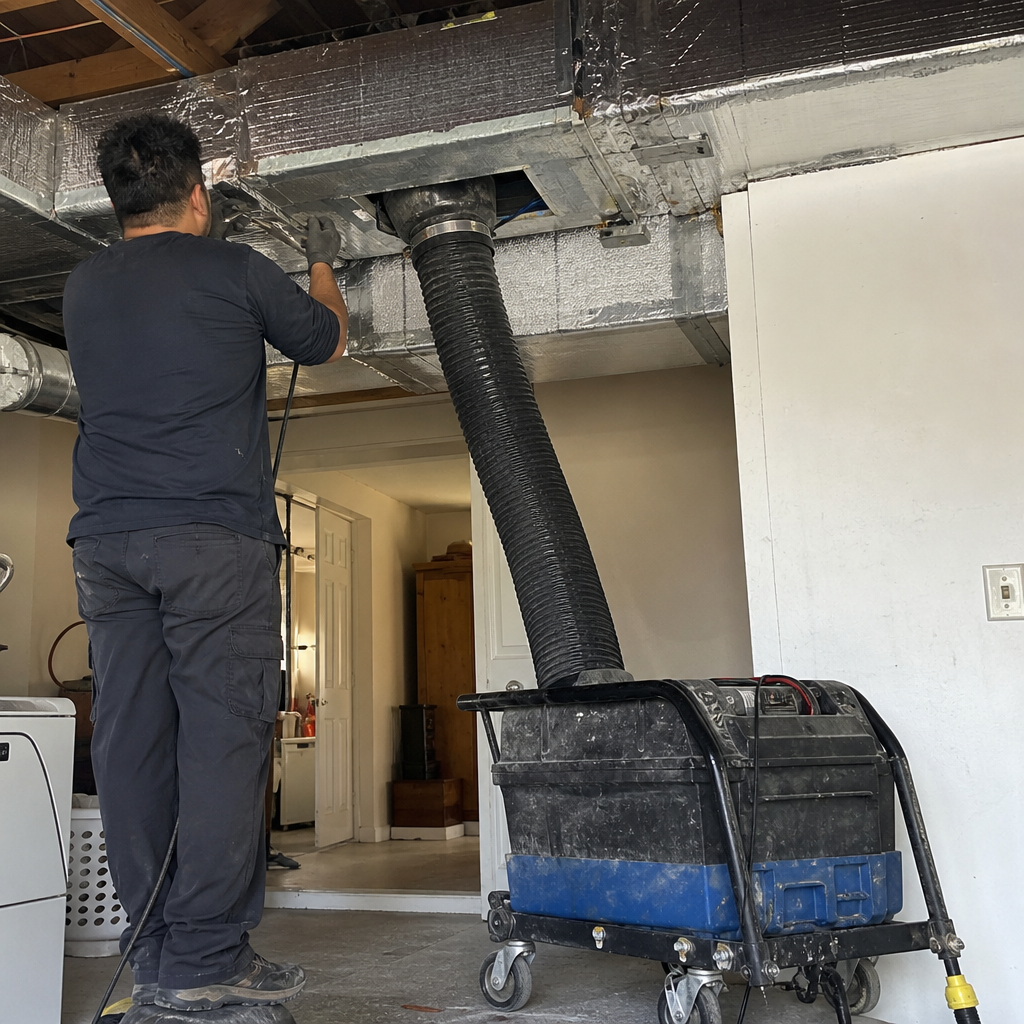
Rigid sheet metal ducts, the kind found in some older Orange homes and commercial buildings, respond differently. Debris settles loosely and moves with airflow. Vaccum-only systems can often handle that. Flex duct requires mechanical contact to break the bond between debris and liner. That’s where the Rotobrush comes in, a rotating brush head on a flexible shaft that physically agitates the liner while vacuum pressure removes what’s dislodged. We use this on every Orange job because it matches what Orange homes actually have.
Orange also has a high percentage of homes with the air handler in the garage or a hallway closet. Return air ducts pull from central living spaces and run through walls and attics that have been exposed to decades of Santa Ana wind dust intrusion, roof repairs, and the occasional rodent. All of that ends up being pulled into the return side of the system. A cleaning that only addresses supply ducts leaves half the system untouched.
Contact Cleaning vs. Vacuum-Only: The Mechanical Difference
Not all duct cleaning methods are equal. The industry divides into two basic approaches: vacuum-only extraction and contact cleaning. Understanding the difference – covered in depth in DIY vs Professional Air Duct Cleaning: The Orange Homeowner’s Decision Guide – helps you evaluate what a company is actually offering before they quote you a price.
Vacuum-Only Systems
A vacuum-only system connects a high-powered vacuum to the duct system, typically through a hole cut in the main trunk line, and pulls air through the ducts. Some systems also blow compressed air into branch runs to dislodge loose material. The advantage is that it’s fast. The limitation is that it removes only what’s already loose. In a flex duct system with compacted debris, vacuum-only leaves the bonded material in place. The ducts may look cleaner at the register openings, but the liner still carries its accumulated load.
Contact Cleaning with Rotobrush
Contact cleaning puts a mechanical tool inside the duct that makes physical contact with the liner. The Rotobrush system uses a rotating brush head with nylon bristles sized to the duct diameter. As the brush spins, it scrapes the liner surface, breaking up compacted debris while the vacuum on the truck or trailer maintains negative pressure to pull the loosened material out as it’s dislodged. The brush is guided through the entire length of each branch run, one at a time.
This is the method that works on Orange’s aging flex duct, as detailed in The Complete Guide to Air Duct Cleaning in Orange. The mechanical action is what gets the bonded dust off the liner. Vacuum-only systems are better suited to maintenance cleaning on sheet metal systems that get serviced regularly. Most Orange homes haven’t been cleaned since installation, which means contact cleaning is the appropriate starting point.
We pair the Rotobrush with Abatement Technologies negative-air equipment. That’s a HEPA-rated system that pressurizes the ductwork and captures particles down to 0.3 microns. The point is containment. Without negative air, mechanical agitation can push dust into the living space. With it, the dust moves toward the collection point, not away from it. Captured, not circulated.
What a Full-System Clean Actually Includes
If you hire a company and they only clean the supply ducts, you’ve paid for a partial job. A full-system clean addresses every component of the air distribution system. Here’s the sequence that should happen on a proper Orange duct cleaning job.
- System inspection. The technician removes the register covers and inspects visible duct interiors with a camera. The air handler cabinet, blower fan, evaporator coil, and return plenum get checked. This step identifies damage, mold, pest activity, and debris type before cleaning begins.
- Supply duct cleaning. Each supply branch run is cleaned individually using contact tools. Register covers are removed, the flexible shaft is worked through the full run length, and the debris is pulled back toward the negative-air collection point. This includes the branch runs, boots, and register openings.
- Return duct cleaning. The return side usually carries more debris than the supply side because it pulls air from living spaces and often has a larger opening. Return ducts get the same contact treatment, running from each return register back to the return plenum.
- Air handler and blower cleaning. The blower fan blades accumulate dust that throws off balance and reduces airflow. The evaporator coil, if accessible, gets inspected and cleaned. A dirty coil costs efficiency and can hold mold. This component lives in the air stream, and a duct clean that skips it leaves the system’s central component untouched.
- Return plenum and coil cavity. The return plenum, the chamber where return air collects before filtering through the coil, often holds construction debris, drywall dust, and pet fur. It should be vacuumed and cleaned as part of the job.
- Final verification. After cleaning, a camera inspection documents the liner condition in representative runs. Airflow is measured at registers before and after. You should see the difference in both the video and the numbers.
Some companies skip the air handler and coil because they’re harder to access. That’s the part you should ask about before booking. A company that won’t show you the air handler is a company that’s not cleaning the part that matters most to your IAQ.
How Much Air Duct Cleaning Costs in Orange
Pricing for air duct cleaning in Orange varies based on home size, number of systems, and accessibility. Here are realistic ranges for Orange’s typical housing stock, which runs from 1,200 to 3,500 square feet.
- Small single-story homes (1,200 to 1,800 sq ft, 8 to 12 ducts): $450 to $700
- Mid-size two-story homes (1,800 to 2,600 sq ft, 12 to 18 ducts): $600 to $950
- Large homes (2,600 to 3,500 sq ft, 18+ ducts, multiple systems): $850 to $1,200
- Dryer vent cleaning as an add-on: $75 to $150 when bundled with duct cleaning
- Air duct repair (damaged flex run replacement, panned joist repair): $150 to $400 per run, depending on access
These are whole-system prices, not per-vent pricing. Be wary of quotes that advertise a low dollar amount “per vent.” That pricing model often results in surprises when the technician arrives and the invoice multiplies. We quote one flat price per system before work starts, agreed in writing. You know the total before we arrive, and the total doesn’t change unless you approve additional repair work.
Orange’s competition keeps prices honest, but the range exists for a reason. A 1970s single-story with a short attic crawl and original flex duct is a different job than a 1990s two-story with clean runs and good access. The cheapest quote is usually cheapest for a reason. It’s often a vacuum-only job that skips the air handler. The most expensive quote should be justified by equipment and process. Ask what equipment they use and whether the air handler and coil are included.
How to Verify the Job Was Done Right
Duct cleaning is one of those services where the seller knows more than the buyer. That asymmetry breeds distrust, and that distrust is earned. It also has a fix. Here’s what any Orange homeowner should ask for to verify the work.
Before-and-After Airflow Measurements
An anemometer, a handheld device that measures air velocity, takes a reading at each register before cleaning and again after. A clean system moves more air. The numbers should improve at every register. If a technician can’t show you measurements, ask why.
Post-Clean Camera Inspection
After cleaning, the technician should run a camera through representative supply and return runs and show you the footage. The liner should be visibly clean, with no remaining debris, no standing dust, and no gaps or tears. If a run was skipped, the video will show it. This takes ten minutes and a serious company does it as standard practice.
Physical Inspection of the Air Handler
Open the air handler cabinet with the technician. Look at the blower fan. It should be clean, not caked with lint. If the coil is accessible through a panel, ask to see it. A proper coil cleaning removes the gray mat of dust and debris that blocks airflow. If the technician won’t open the cabinet, that’s a red flag.
In Orange, we’ve found that the verification conversation changes the outcome. Homeowners who ask for before-and-after numbers and camera proof get better results, and the companies that provide them tend to be the ones that do the work properly in the first place. It’s the most reliable way to separate a real clean from a surface visit.
Orange-Specific Factors: Wind, Gas Appliances, and Slab Foundations
Orange’s environmental and construction patterns shape what’s in your ducts and how often they need attention. Three local factors stand out.
Santa Ana Wind Season Dust Loading
From September through November, Santa Ana winds push fine dust and particulate across the region. Homes near the eastern edge of Orange, closer to the foothills and Villa Park, feel this more than homes near the 5 freeway. That dust enters the house through open windows, door gaps, and attic vents, then settles in the return registers and gets pulled through the system. Orange homeowners often notice the system gets dirtier faster during Santa Ana season than during the rest of the year. If you run the HVAC during Santa Ana events with windows open, you’re actively feeding dust into the return side.
Gas Appliances and Duct Proximity
SCE and the Gas Company serve Orange’s housing stock, and many homes, especially those built before the 1990s, have gas-fired furnaces. The furnace shares cabinet space with the evaporator coil and blower. When a gas furnace runs, it creates its own particulate. If the return duct is pulling air from a garage or from near the furnace itself, combustion residue and garage dust get drawn in. This is especially relevant in homes where the air handler lives in the garage, a common Orange configuration. The return plenum in those homes needs cleaning more often than in homes with the unit in a hallway closet.
Slab-on-Grade Homes and Under-Slab Ductwork
A portion of Orange’s 1960s and 1970s tract housing was built slab-on-grade with supply ducts running under the concrete slab. If your home has under-slab ductwork, you have a different set of concerns. Under-slab ducts can accumulate moisture, and in some cases have cracked or shifted over the decades. Cleaning under-slab ducts requires specialized access and should be paired with a camera inspection to check for water intrusion and damage. Several Orange neighborhoods along Tustin Street and near the old orange groves have this construction style. If you’re not sure whether your home has under-slab ducts, check the register location. Floor registers, especially in the middle of the slab, indicate under-slab runs. Wall and ceiling registers indicate attic or wall-stack runs.
These factors don’t mean Orange homes need a fundamentally different service. They mean the service needs to be adapted to what’s present. A technician who knows Orange’s housing patterns, slab foundations, wind seasons, and appliance configurations is more likely to catch problems during the cleaning than one who treats every home the same.
How Often Do Orange Homes Really Need Duct Cleaning?
The air duct industry has argued about frequency for decades. Here’s a direct answer for Orange homeowners.
Most Orange homes need duct cleaning every 4 to 7 years. The range depends on five factors: household size, pets, renovation history, the presence of gas appliances, and whether the home is in a high-dust zone near the 55 or 5 freeways. Homes with multiple shedding pets should lean toward the 4-year side. Homes with no pets, a newer system, and regular filter changes can stretch to 7 years.
There are times when you should clean sooner. After a renovation that involved drywall cutting, floor sanding, or tile grinding, schedule a cleaning. The dust from a kitchen remodel or a new addition gets pulled into the return ducts and coats the liner. We’ve seen Orange homes six months after a remodel with return ducts that looked like they’d never been cleaned. Construction dust is finer than household dust, more abrasive, and tougher to dislodge.
Allergy symptoms that improve when you leave the house and worsen when you return are a signal. So is visible dust on the register covers, a musty smell when the system starts, or reduced airflow from vents that used to blow harder. If you have a Honeywell or Aprilaire whole-home IAQ system, check the filter, but the ducts still need attention on the same timeline. Those systems clean and condition air, but they don’t remove debris that’s already bonded to the duct liner.
A new home purchase is another trigger. When you buy a house in Orange, you don’t know when the ducts were last cleaned, if ever. The previous owner’s pets, renovations, and habits are now your air stream. This is one of the most common reasons Orange homeowners call us, and it’s a sensible one. Clean ducts are a known starting point in an unknown house.
How to Choose a Duct Cleaning Company in Orange
The duct cleaning industry has a reputation problem. The low barrier to entry means anyone with a truck and a vacuum can claim to clean ducts. Orange homeowners deserve a better standard. Here’s what to look for when you’re comparing companies.
Ask About Equipment, Specifically
A serious company runs professional-grade equipment and is proud to name it. Ask what they use. If the answer is “professional equipment, ma’am,” that’s not an answer. Companies that use Rotobrush or Nikro contact-cleaning systems paired with Abatement Technologies negative-air containment can tell you exactly what they run and why. Companies that can’t name their equipment are using something they’d rather not tell you about.
Ask Whether They Repair What They Find
During cleaning, some problems come to light: a torn flex run, a disconnected boot, a collapsed section of duct in the attic. If the company only cleans and doesn’t repair, you’ll end up calling a second contractor to fix what the first one found. Air Duct Repair in Orange as a service means the technician who finds a problem can fix it in the same visit. It’s the difference between a surface visit and a full-system fix.
Ask What’s Included in the Price
“Duct cleaning” should mean supply ducts, return ducts, the air handler, the blower, the coil cavity, and the return plenum. If the quote doesn’t say that in writing, the job won’t include it. Get the scope in writing before you book. The price should be one flat price per system, not a per-vent multiplication that can balloon on site.
Ask for Verification
Before-and-after airflow measurements and a post-clean camera inspection should be standard. If a company balks at either, keep looking. Verification is what protects you from paying for a job that wasn’t done.
If you’re in Orange, you can call Crisp Duct Cleaning home office for more information. We explain what we’ll do before we quote, we show you the work when it’s done, and we’ll repair any damage we find instead of leaving you with a problem and a phone number for someone else.
Common Mistakes to Avoid
- Skipping the air handler. The blower and coil live in the air stream. Cleaning the branch runs and ignoring the air handler is like washing the car but leaving the engine covered in grime. In Orange’s garage-installed units, this is where the worst buildup lives.
- Falling for per-vent pricing. The advertised price is per vent, and the shrunken total triples by the time the technician tallies the supply and return registers. Ask for one flat price per system in writing.
- Ignoring the return side. The return ducts carry the air from your living spaces back to the system. If they’re dirty, you’re recirculating the same debris. A proper clean covers both supply and return, and the return usually needs it more.
- Cleaning only after a problem starts. Duct debris builds gradually. By the time you see dust blowing from the registers or smell must in the system, you’ve been breathing the stuff for months. Set a reminder on a 4 to 7 year cycle, sooner with pets or after renovations.
- Hiring based on price alone. Orange has dozens of duct cleaning companies, and the lowest quote usually means vacuum-only cleaning, no air handler access, no verification. You don’t need the most expensive option, but you should know what the cheap one leaves out.
- Forgetting the dryer vent. Dryer vents are a separate system from the HVAC ducts, but they share the same problem: lint buildup. Dryer Vent Cleaning in Orange addresses a leading cause of residential fires, and it’s a service most Orange homeowners have never scheduled.
When to Call a Professional
If your home was built before 1995 and you don’t know whether the ducts have ever been cleaned, it’s time to find out. If you’ve recently renovated, added a pet, noticed dust around the registers, or have breathing issues that worsen when the system runs, schedule a cleaning. If you see mold on the register covers or smell something unpleasant when the heat comes on, don’t wait. Duct cleaning isn’t a cosmetic service. It affects airflow, equipment life, and the air you breathe every day. Crisp Duct Cleaning offers free estimates in Orange. Call (833) 593-4428 and we’ll inspect your system, show you what’s there, and tell you whether cleaning is worth doing now or can wait.
Frequently Asked Questions
Most Orange homes run between $450 and $1,200 for a full-system clean depending on size, number of systems, and duct accessibility. We quote one flat price per system before work starts, so the total is known before we arrive. Call (833) 593-4428 for a free no-obligation estimate for your home.
Cheaper quotes usually reflect narrower scope, vacuum-only equipment, and skipped components like the air handler and coil. The per-vent pricing model also makes quotes look smaller than they are. Ask what the price includes and what equipment will be used, then compare on the same basis.
You should receive before-and-after airflow measurements at each register and a post-clean camera inspection showing the duct liner in representative runs. If a company won’t provide these, that’s a signal the work may not be verifiable. Direct visual proof is the standard.
For most Orange homes, every 4 to 7 years. Homes with pets, frequent renovations, or gas appliances in the garage may need it sooner. If you’ve never had it done and the home is more than 20 years old, it’s overdue.
It can, if the ducts are the source. Debris trapped in flex duct liner circulates every time the system runs. Cleaning removes that material and reduces the particulate load in your air stream. Allergy sufferers often notice a difference within weeks, especially in Orange homes that run the system heavily during summer and winter months.
Air duct cleaning serves your HVAC system’s supply and return ducts. Dryer vent cleaning clears the exhaust line from your dryer to the outdoors, which fills with lint and creates fire risk. They’re separate systems and separate services, and both need periodic attention.
The Bottom Line
Orange’s housing stock, dominated by 1970s through 1990s tract homes with flex duct, makes professional-grade contact cleaning the right approach for most homes in the city. A real clean covers supply and return ducts, air handler, blower, coil, and plenum, delivered by a company that verifies the work with measurements and camera footage. Local conditions like Santa Ana dust loading, garage-mounted gas furnaces, and under-slab ductwork change what’s inside your system and how often it needs cleaning. Choose a company that names its equipment, repairs what it finds, and quotes one flat price per system. If you’re ready to schedule, Air Duct Cleaning in Orange from Crisp Duct Cleaning starts with a free estimate and a system inspection. Call (833) 593-4428.
Written by the team at Crisp Duct Cleaning, serving Orange since 2012.