
Last updated November 2, 2026
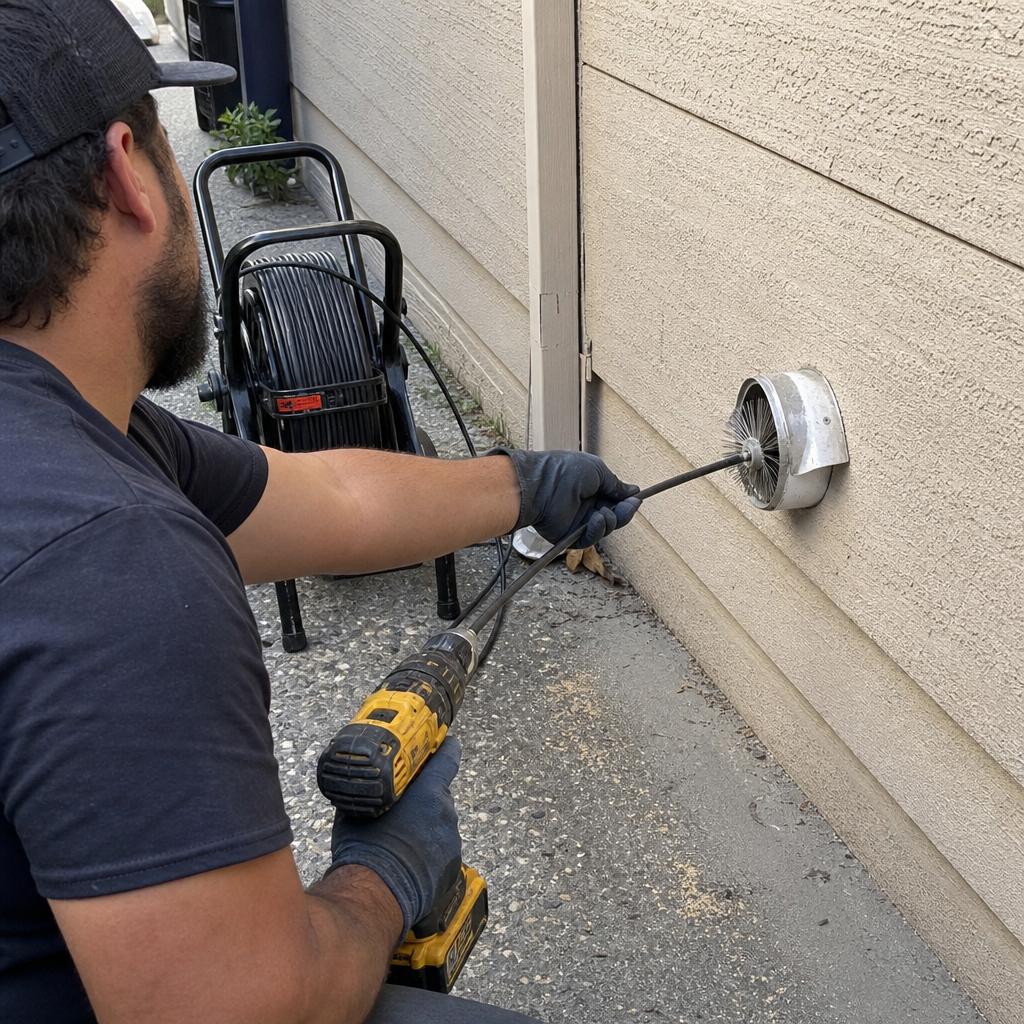
Whole-system duct and dryer vent check with before-and-after photos - you see exactly what came out of your vents
That "$99 whole-house special" is a bait ad - the real number appears once they are in your hallway, or the "clean" is a shop-vac at the register. We photograph the inside of your ducts before and after instead.
Air Duct Cleaning Warning Signs: An Orange Homeowner’s Reference Guide
Most “warning signs” articles for duct cleaning read like a list of vague symptoms: dusty house, musty smell, high energy bills. That’s not a diagnostic guide; that’s a guess. Here in Orange, where our warm, dry climate means windows stay closed and HVAC systems run for months at a stretch, a dusty house has six possible causes. Three of them have nothing to do with duct cleaning at all. The difference between a $400 duct cleaning you need and a $400 duct cleaning you don’t comes down to reading specific signals accurately. This guide exists so you can walk into a conversation with any contractor in Orange, describe exactly what you’re seeing at your registers, feel the air at your return, and know whether you’re looking at a filtration problem, a duct leak, a contaminated air handler, or a genuine Air Duct Cleaning services job. By the end, you’ll know the tests, the thresholds, and the specific visual cues that separate real duct disease from normal household dust. No other reference guide written for Orange homeowners goes into this level of diagnostic specificity. That’s the point.
Quick Answer
The clearest duct-specific warning signs in Orange are visible debris accumulation inside supply registers, consistent gray particulate blowing from vents when the system runs, rooms that never reach set temperature despite the system cycling normally, and return registers that show a uniform gray coating you can wipe with a finger. Dirty ducts are rarely the cause of general “dusty house” complaints on their own; a true duct problem presents as specific, repeatable, localized signals that point to the ductwork itself rather than the filter, the air handler, or the building envelope. Read the register first, the temperature second, and the air pattern third.
Styles & brands we work with
- Whole-home duct cleaning
- Dryer vent cleaning
- Camera inspection
- Sanitizing & deodorizing
Table of Contents
- The Dusty-House Differential: What Actually Lives in Your Ducts
- Register Evidence: Reading Supply and Return Registers Like a Technician
- The Pressure-Temperature Test: Mapping Duct Leaks by Temperature Differential
- The Orange Wind Event: Gray Particulate After Santa Anas
- Was My Last Cleaning Incomplete? Spotting Equipment-Grade Failure
- Mold, Pests, or Debris: Telling the Three Apart
- Air Handler and Filter Problems That Mimic Dirty Ducts
- The Timeline Signal: When Symptoms Appeared and What That Means
The Dusty-House Differential: What Actually Lives in Your Ducts
A dusty house is the most common reason Orange homeowners start researching The Complete Air Duct Cleaning Guide for Orange Homeowners. The problem is that household dust has six distinct sources, and only two of them involve ductwork. Understanding which one you’re dealing with determines whether you need duct cleaning, a filter upgrade, an air handler service, or a can of expanding foam around a window frame.
The six sources break down as follows:
- Return-air filtration failure: The filter isn’t catching fine particulate, either because it’s the wrong MERV rating for your system, it’s loose in its slot, or it’s been installed backward. This is the most common cause of dusty houses in Orange, and it has nothing to do with duct cleanliness.
- Envelope leakage: Dust entering through unsealed windows, door frames, exterior wall penetrations, and – critically in Orange’s older ranch-style neighborhoods – through worn weatherstripping or uncaulked baseboards. If your dust is worse during Santa Ana wind events, this is your likely culprit.
- Air handler contamination: The blower wheel, evaporator coil, or drain pan inside the air handler is holding dust and debris. When the unit runs, it re-aerosolizes whatever’s caked on those components. This is an air handler problem, not a duct problem, and cleaning the ducts without cleaning the air handler is like washing your car and leaving the engine covered in silt.
- Duct leakage (return side): Return ducts pulling unconditioned air from attics, crawl spaces, or wall cavities. In Orange, where return ducts frequently run through unconditioned attics that hit 130°F in August, a small return leak sucks in fiberglass insulation particles and attic dust every time the system runs.
- Duct leakage (supply side): Supply ducts pushing conditioned air out through gaps in joints, boots, or register connections. This doesn’t cause dust inside the home, but it causes the pressure imbalance that pulls dust in through envelope leaks.
- Accumulated debris in the ductwork itself: Dust, pet hair, and construction debris that’s been sitting in the ducts for years, slowly eroding and circulating when airflow conditions change. This is what duct cleaning actually addresses.
The diagnostic key: if dust settles evenly across every surface in the home within 24 hours of cleaning, you’re likely looking at filtration, envelope, or air handler issues. If dust accumulates more heavily in specific rooms, particularly the rooms furthest from the air handler, you’re more likely looking at duct-specific problems like leakage or accumulated debris being distributed unevenly by system pressure patterns. In our experience serving Orange homes from the historic Old Towne district to the newer developments off Santiago Canyon Road, the most common finding in genuine duct-cleaning cases is not uniform house dust but uneven dust distribution concentrated in one or two rooms fed by long duct runs.
Register Evidence: Reading Supply and Return Registers Like a Technician
Your registers are the only visible endpoints of a duct system that’s otherwise hidden behind drywall. Every supply register and return grille in your Orange home is a diagnostic window. Here’s what the evidence at the register tells you, and what each finding means.
Supply Registers: What to Look For
Remove a supply register (usually held by two screws or friction clips) and look inside using a flashlight. Here’s the classification system we use on every inspection in Orange:
- Light gray, dusty coating on the inside of the boot: Normal accumulation over 3-5 years. This is household dust that’s been deposited by the moving air column. If it’s uniform, thin, and wipes off easily, this is the low end of the cleaning-need spectrum. It indicates the system has been moving air normally and depositing fine particulate at edges and corners.
- Heavy gray-brown accumulation with visible “layers”: This is the point where cleaning becomes genuinely beneficial. Layered dust on a register boot means debris has been cycling through the system for a long time, and the interior of the main trunk lines likely shows similar accumulation. In Orange’s low-humidity environment, this dust tends to be fine and powdery rather than sticky, which actually makes it easier to remove with professional-grade equipment but also easier to distribute through the house when disturbed by a poorly executed cleaning.
- Black or dark green discoloration at the register edge or inside the boot: This warrants a closer look, but don’t panic. In Orange, where we don’t have the persistent high humidity of Gulf Coast or Southeast climates, true mold growth inside ducts is relatively uncommon. What looks like mold at a register is more frequently years of dust accumulation stained by temperature differentials, or it’s visible growth on the register itself from condensation cycles. Distinguishing between them matters because the response is different: stained dust calls for cleaning; active mold calls for cleaning plus addressing the moisture source.
- Visible debris fragments, pet hair clumps, or construction dust: This is the most unambiguous duct-cleaning indicator. When you can see granular debris, hair, or drywall dust fragments at the register boot, the system has been moving and depositing larger particulate that should have been stopped by a functioning filter. This means either the filter has been bypassed at some point, or the debris predates the current filter and has been cycling through the system ever since.
Return Registers: The Intake Diagnosis
Return registers tell a different story. While supply registers show what the system is pushing out, return registers show what it’s pulling in. Here’s what to look for at any return in your Orange home:
- Uniform gray coating across the grille surface: This is the classic “dirty ducts” visual that most Orange homeowners first notice. It’s also the most commonly misinterpreted. A uniform gray coating on a return grille means the system has been filtering air through that grille, and the filter is doing at least partial work. It indicates the return is pulling air, the filter is catching some of the particulate, and the grille itself is acting as a pre-filter. This is normal and doesn’t by itself indicate dirty ducts.
- Gray coating on the grille but a clean filter: This is the interesting case. If your return grille is visibly dusted but the filter behind it looks clean, the filter may be bypassing air around its edges. Check whether the filter fits tightly in its slot. In many Orange homes, particularly older custom-built properties where filter slots were hand-fabricated, the slot is slightly oversized for standard filter dimensions, allowing air to flow around rather than through the filter media. This sends unfiltered air into the system, which then deposits dust throughout the ductwork and into supply registers.
- No visible dust anywhere on the return but heavy dust at supply registers: This points away from duct cleaning and toward the air handler. If the return side is clean and the supply side is dirty, the dust is entering somewhere between the filter and the supply registers. That’s usually the air handler itself: blower wheel, coil, or drain pan.
The Pressure-Temperature Test: Mapping Duct Leaks by Temperature Differential
Dirty ducts and leaking ducts are different problems requiring different responses. Cleaning a system with a significant supply-side leak is like mopping the floor while the window’s open during a dust storm. Here’s the test any Orange homeowner can perform without any special equipment beyond two thermometers and ten minutes.
Step-by-Step: The Temperature Differential Test
- Set your thermostat to a consistent temperature (72°F works well) and let the system run for 15-20 minutes until it reaches steady-state operation.
- Measure the temperature at each supply register using an instant-read or infrared thermometer. Write down the number for every register in the house.
- Compare the readings. In a properly functioning duct system, supply temperatures should be within 3-4 degrees of each other across all registers. A room fed by a longer duct run will naturally run 1-2 degrees warmer, but a spread of 6, 8, or 10 degrees between rooms signals a problem.
- Identify the outlier rooms. The room or rooms with the warmest supply air are the ones losing conditioned air to leakage. The air is leaving the duct through a joint, boot, or connection point before it ever reaches the register.
- Check the return side. Close the door to the outlier room and feel for air movement at the bottom of the door. If the room has no dedicated return and the door gap is normal, the room may be over-pressurized by supply air that has nowhere to go. This is common in Orange homes where returns were originally sized for single-room heating systems and never upgraded for central air conditioning.
A consistent 6+ degree temperature spread between rooms in summer is the single most reliable indicator of duct leakage in Orange homes. It also explains why one bedroom in a typical Orange ranch stays warm all summer while the rest of the house cools normally. Dirty ducts don’t cause temperature differentials of this magnitude. Leaking ducts do. The distinction matters because duct leakage is a repair problem, not a cleaning problem. Air duct cleaning will make the system cleaner, but it will not fix the temperature imbalance. In our experience at Crisp Duct Cleaning, when an Orange homeowner calls about uneven temperatures, we find a combination of dirty ducts and some degree of duct leakage in roughly 70% of cases. That’s why we offer air duct repair in Orange as a companion service to cleaning; finding and fixing the leaks during the same visit eliminates a second dispatch.
The Orange Wind Event: Gray Particulate After Santa Anas
One warning sign is specific enough to Orange that it deserves its own section. Santa Ana wind events, which typically occur between October and February, push fine dust and particulate from the inland deserts toward the coast. Homes in Orange experience these events as hours or days of sustained wind that drives fine gray or tan dust into every exterior crack, soffit vent, and unsealed penetration.
What Orange homeowners often notice after a Santa Ana event is a fine gray dust that settles on window sills, on furniture, and – crucially – around supply registers and on surfaces immediately beneath them. Here’s the diagnostic distinction: if the dust is settling on horizontal surfaces throughout the house, it’s likely entering through the envelope: windows, doors, wall penetrations, and foundation cracks. If the dust is specifically appearing at supply registers or being blown into specific rooms when the system runs, it may be entering through the duct system itself.
The test is simple. After the next Santa Ana event in Orange:
- Turn your system off for 4-6 hours.
- Wipe down the top surfaces of all supply registers with a clean white cloth.
- Run the system normally for one full cycle.
- Re-wipe the same surfaces.
If the second cloth comes back with gray dust that wasn’t there before the system ran, that dust is coming through the ducts. The mechanism is usually a return-side duct leak in an unconditioned attic or crawl space. During high-wind events, the wind creates differential pressure across the building envelope. Any gap in a return duct, especially at joints or where the duct connects to boots or plenums, acts as an intake for wind-driven dust and attic insulation particles. That dust enters the return airflow, passes through the filter if it’s at the air handler rather than at the return grille, and then distributes through the supply side of the system.
This is a specific, testable, repeatable signal. If you see gray particulate at supply registers specifically after wind events and only when the system is running, you have a return-side duct leak or insufficiently sealed return connections. This is where our Abatement Technologies negative-air equipment matters: when we clean ducts in Orange homes after wind-driven contamination, we capture the fine particulate during the cleaning process rather than circulating it back into the living space. The dust from a Santa Ana event is especially fine, and equipment that isn’t designed for fine particulate capture will simply aerosolize it through the house. You’ll know within minutes whether a cleaning contractor’s equipment is capturing or recirculating.
Was My Last Cleaning Incomplete? Spotting Equipment-Grade Failure
Not all duct cleanings are equal. The difference between a $99 advertised duct cleaning and a professional-grade service is not the price; it’s the equipment and the thoroughness. For help evaluating providers, see our guide on Choosing the Right Air Duct Cleaning Brand: A Buyer’s Guide for Orange. Orange homeowners who have had ducts cleaned before and are wondering whether that cleaning did anything can check specific, observable evidence.
A properly cleaned register boot, when inspected with a flashlight, should look like this: clean metal or plastic interior surfaces with no visible dust coating, no debris fragments in the corners, and no accumulation at the seams or screw points. The boot should look clean enough that you would wipe your hand across it without concern. If any of the following are present, the previous cleaning was incomplete or performed with inadequate equipment:
- Heavy dust visible at the register boot more than 2 inches inside the boot: A proper cleaning runs the vacuum or agitation device through the entire boot and into the branch line. A cleaning that only addresses the main trunk lines leaves every branch line and every boot untouched. Since the boot is the last several feet of the duct run, seeing dust there means the cleaning never reached that section.
- Visible debris inside the register itself: The register grille should have been removed, cleaned, and replaced during the service. If you can see pet hair or dust bunnies caught in the grille fins after a “completed” cleaning, the contractor neither removed nor cleaned the registers.
- Dust reappearing at supply registers within 2-3 weeks of cleaning: This is the telltale signature of a cleaning that only addressed the main trunk lines, or a cleaning performed with contact vacuum equipment that loosened debris in the branch lines without capturing it. The debris was disturbed, entered the air stream, and re-deposited at the nearest supply register. In our experience, this is most common with low-cost cleanings that use consumer-grade or undersized equipment and treat the job as a “blow and go” rather than a full-system capture and extraction.
- No observable change at the air handler: A complete duct cleaning should include or at least indicate the condition of the air handler. If the blower wheel, evaporator coil, and drain pan were never touched, the cleaning addressed only part of the system. The air handler is the most contaminated component in most Orange HVAC systems, and cleaning the ducts while leaving the air handler dirty means the system re-contaminates the ducts within months.
This is where equipment makes a difference you can see. Our Crisp Duct Cleaning crews run Rotobrush and Nikro systems, purpose-built for duct cleaning, paired with Abatement Technologies HEPA-rated negative air machines that keep the system under continuous negative pressure during the entire cleaning process. The distinction matters: negative-air equipment captures debris at the point of agitation. It’s the difference between vacuuming a rug and beating it with a broom on a windy day. The debris either gets captured or it recirculates. We’d rather show you the collection bag after the job than explain away a dusty house the next week. And if you’re unsure whether your last cleaning in Orange was done properly, we’ll inspect the system and tell you straight: it’s clean, or it’s not.
Mold, Pests, or Debris: Telling the Three Apart
Three distinct problems can show up in ductwork, and each requires a different response. Orange homeowners should know how to distinguish them before calling a contractor, because the response differs significantly in scope and cost.
Debris accumulation is the most common finding. It presents as gray, tan, or brown dust that’s uniform in distribution and wipes off easily with a dry finger. In Orange, where the air is dry for most of the year, accumulated duct debris tends to be fine and loose rather than sticky or damp. Debris accumulation responds to cleaning. It’s the straightforward case.
Mold growth in ducts requires both elevated moisture and a food source. In Orange’s climate, true mold growth inside ductwork is relatively uncommon compared to humid regions of the country. When we do find it, it’s almost always tied to a specific moisture issue: a condensate leak from the air handler, a plumbing leak that saturated a floor register area, or a run of flex duct that trapped moisture during a previous event. Mold in ducts appears as dark spots or patches at specific locations, often concentrated where moisture has been present, not as a uniform gray coating. The response is different: cleaning plus identifying and correcting the moisture source. If you clean mold-affected ducts without fixing the moisture problem, the mold returns.
Pest intrusion is the third category and one Orange homeowners encounter more frequently than mold. Rodents, particularly roof rats which are common in the mature landscaping of Orange’s older neighborhoods, can access ductwork through gaps at boots, damaged flex duct, or openings where ducts penetrate the attic floor. The evidence is specific: droppings visible inside the duct, gnaw marks on register edges, or debris that includes nesting material rather than household dust. Pest intrusion requires extermination first, then duct repair to close the entry point, then cleaning to remove the contamination. In Orange, where roof rats have been an established presence for decades, this sequence is well-documented and any experienced local contractor will be familiar with it.
Real-world Orange case: we inspected a home in the Taft Avenue corridor where the homeowner had called three duct cleaning companies about “black debris” coming from a bedroom register. Two quoted cleaning. The third did what we do: pulled the register, looked inside, and found the nesting material. The duct cleaning wouldn’t have solved the pest problem, and the debris would have been back within a month. We fixed the entry point, sealed the duct connection, and then cleaned the contaminated section. The response is different because the diagnosis is different. Any contractor who quotes cleaning without putting eyes on the actual condition inside the duct isn’t diagnosing; they’re guessing.
Air Handler and Filter Problems That Mimic Dirty Ducts
Some of the most common “dirty duct” symptoms in Orange turn out to be air handler or filter problems. Here’s how to tell the difference before you pay for a cleaning you may not need.
The filter bypass test: Turn your system off and open the filter access. If your filter is located at the air handler (common in Orange homes where the return grille is a simple grille with no filter slot), inspect the filter frame. Does it fit snugly? Is there visible dust buildup on the filter access door itself? Are there gaps around the filter edges where air can flow around rather than through? If the filter is loose in its slot, unfiltered air has been bypassing the filter and entering the air handler directly. That air carries dust which deposits on the blower wheel, the coil, and eventually the supply side of the system. You don’t need duct cleaning for this; you need the filter slot corrected and the air handler cleaned.
The blower wheel inspection: With the system off, shine a flashlight into the blower compartment (most units have a removable access panel). If the blower wheel fins are coated in a fuzzy gray or brown layer, that’s your dust source. Every time the blower spins, it releases a fine mist of that accumulated dust into the air stream, which pushes it through the supply ducts and into the home. This presents as consistent, fine dust that appears on surfaces near supply registers, especially when the system runs. The issue is the blower, not the ducts, though a full-system cleaning by a technician with the right equipment addresses both at once.
The evaporator coil check: In cooling season, the coil sits wet as it condenses moisture from the air. A dirty coil has reduced efficiency and can also harbor biological growth in the condensate. You can’t easily see the coil without opening the coil access panel, which we don’t recommend for homeowners (refrigerant lines and internal electrical connections are present). What you can observe is the symptom pattern: musty or “dirty sock” odor that’s present when the system runs but fades when it shuts off, especially in early summer when the system first starts cooling. That’s the coil. Duct cleaning alone won’t address it.
This is why our technicians are trained on Honeywell and Aprilaire whole-home IAQ systems as well as the ductwork itself. The duct system doesn’t exist in isolation; it’s one component in an air quality chain that includes filtration, the air handler, the coil, and any supplementary IAQ equipment. Diagnosing a warning sign correctly means understanding how all of those components interact, not just vacuuming the visible parts.
The Timeline Signal: When Symptoms Appeared and What That Means
The timeline of when symptoms appeared is one of the most useful diagnostic tools you can use before calling any contractor in Orange. Here’s how the timing points to the cause:
- Symptoms appeared suddenly after a renovation project: This is construction dust in the ducts. During drywall, flooring, or framing work, fine particulate enters the return side through open duct stubs and distributed through the system when it’s run again. Response: duct cleaning, ideally with a contractor who uses HEPA-rated capture equipment. This is one of the clearest, most unambiguous cases for duct cleaning in Orange.
- Symptoms appeared when you changed filters (or stopped changing them): A filter change that introduced a lower-MERV filter, or a filter that’s been left in place too long, changes the particulate load on the system immediately. Response: check the filter first, run the system for a week, and see if symptoms resolve. If not, consider whether the air handler and ducts have accumulated particulate during the under-filtered period.
- Symptoms appeared after the system was serviced: A blower replacement, coil cleaning, or duct modification can disturb accumulated debris and send it downstream. Response: run the system continuously for a few days and see if the dust clears. If it persists beyond a week, cleaning is warranted.
- Symptoms appeared gradually over years: This is the classic slow accumulation pattern. The system has been depositing dust in problem areas for a long time, and the accumulation has reached a point where it’s visible. Response: cleaning, but with the understanding that gradually accumulated dust often conceals other issues like seal degradation or filter bypass that should be addressed at the same time.
- Symptoms appear only during specific weather conditions: Dust that appears during Santa Ana events points to envelope or return-duct leakage. Musty odors that appear during humid periods point to condensate or coil issues. Symptoms that track with wind, humidity, or seasonal change are diagnostic in themselves.
Common Mistakes to Avoid
- Calling for duct cleaning before confirming the dust source. A dusty house in Orange has multiple potential causes, and cleaning the ducts without identifying the source means paying for work that may not address the actual problem. Run the register and filter tests in this guide first.
- Choosing a contractor based on price per vent. This is the classic bait-and-switch structure in the duct cleaning industry. A low per-vent price becomes a large invoice once the technician “discovers” additional work. Reputable contractors quote a flat price per system, agreed before work begins.
- Assuming all duct cleaning equipment is equivalent. It isn’t. The difference is visible. Consumer-grade equipment and automotive-style vacuums cannot maintain the negative pressure or agitation force needed to clean a residential duct system properly. Ask what equipment the contractor uses. If they can’t name it, that’s an answer.
- Ignoring uneven room temperatures as a separate problem. Dirty ducts and leaking ducts are different conditions. A professional assessment should distinguish between them. Cleaning a system with significant leaks won’t fix the temperature imbalance.
- Confusing stained dust with mold. In Orange’s dry climate, most dark discoloration in ducts is stained dust, not active mold. The response is different, and the wrong diagnosis leads to unnecessary treatment or missed moisture problems.
- Skipping the air handler. Cleaning the ducts while leaving the blower wheel and coil coated in dust means the system re-contaminates the ducts within months. A full-system approach addresses the complete air path.
- Waiting for visible symptoms before investigating. By the time dust is visibly accumulating at registers, the system has been circulating that particulate for a while. If your system hasn’t been cleaned in 5+ years, an inspection is warranted whether or not you’ve noticed symptoms yet.
When to Call a Professional
Call a professional when you’ve run the tests in this guide and found evidence that points to the ducts: visible debris at register boots, gray particulate at supply registers after wind events, uneven dust distribution concentrated in specific rooms, or a previous cleaning that left visible contamination behind. Call when the timeline points to a specific event like a renovation or a long period without filtration. Call when you’ve ruled out the filter and the air handler and the dust pattern still says “ducts.” You don’t need to have a perfect diagnosis before you call; you need to be able to describe what you’re seeing accurately. That’s what separates a productive service call from a guess. Crisp Duct Cleaning offers free estimates in Orange, and we’re glad to talk through what you’re observing before scheduling anything. For more guides & resources, visit our blog. Call (833) 593-4428 and describe what you’re seeing at your registers. We’ll tell you whether what you’re describing sounds like ducts, air handler, filter, or envelope, and we’ll recommend the appropriate next step whether or not it involves our services.
Frequently Asked Questions
The most reliable indicators are visible debris inside the register boots when you remove a register and look in with a flashlight, consistent gray particulate appearing at supply registers when the system runs, or dust that reappears within weeks of a previous cleaning. Uniform house dust on furniture is rarely a duct-specific signal in Orange homes.
In Orange, a full-system residential duct cleaning typically ranges from $450 to $900 depending on the size of the home and the number of systems. The price should be quoted as a flat rate per system, agreed before work begins. If you’ve been quoted a per-vent price, especially a low teaser figure, the final invoice will likely be significantly higher than the advertised number.
The variance comes down to equipment, time, and scope. A $99 advertised cleaning usually involves minimal equipment, minimal time, and a scope limited to the main trunk lines only. A full-system cleaning with professional-grade equipment from manufacturers like Rotobrush and Nikro, paired with HEPA-rated negative air capture, takes several hours and costs more because it addresses every branch line, register boot, and the air handler. The lower quote is usually not the same job.
Ask to see before-and-after photos of the interior of the ductwork, captured with a borescope or inspection camera. Ask to see the debris collected during the cleaning. Check the register boots yourself after the job with a flashlight. A properly cleaned boot interior is visibly clean, not dusty. If your contractor can’t show you any of this evidence, you have reason to be skeptical.
In many Orange homes, the answer is both. Systems that have operated for years with minor leaks at joints and connections will have accumulated dust that leaked-in air brought with it. Cleaning the ducts without sealing those leaks means the problem continues. A professional inspection should identify whether duct leakage is present and recommend sealing as part of the scope. Air duct repair in Orange is a separate service, but when combined with cleaning, it’s a full-system fix rather than a temporary improvement.
For most Orange homes, every 4 to 6 years is a reasonable interval. Homes with pets, recent renovations, or occupants with respiratory sensitivities may benefit from more frequent service. Homes with high-MERV filtration and tight ductwork can often go longer. The timing should be driven by inspection and observed conditions, not by a fixed schedule. Call (833) 593-4428 if you’re unsure whether your system is due, and we’ll help you assess it without pressure.
The Bottom Line
Duct cleaning in Orange is a diagnosis-driven decision, not a subscription. The warning signs that matter are specific and observable: debris at the register boot, wind-driven particulate at supply registers, uneven dust distribution between rooms, and visible evidence after a renovation or filter failure. The signs that don’t point to ducts are equally important to recognize: uniform house dust, temperature issues caused by leaks rather than dirt, and contaminated air handlers that need component-level service. Learn to read your registers, run the temperature differential test, and know what your filter is or isn’t doing. When the evidence points to the ductwork, professional air duct cleaning in Orange with proper equipment and HEPA-rated capture is a straightforward, effective fix. When it doesn’t, you’ll have saved yourself the cost of a service that wouldn’t have solved the problem. At Crisp Duct Cleaning, we’d rather help you arrive at the right diagnosis than sell you the wrong service. Call (833) 593-4428 for a free estimate, and if you have a dryer vent that hasn’t been cleaned in recent memory, ask about dryer vent cleaning in Orange while you’re at it. Those two services address different systems, and both deserve their own attention.
Written by the team at Crisp Duct Cleaning, serving Orange since 2012.
Return to the Crisp Duct Cleaning home page to learn more about our full-system approach.