
Last updated November 2, 2026
Whole-system duct and dryer vent check with before-and-after photos - you see exactly what came out of your vents
That "$99 whole-house special" is a bait ad - the real number appears once they are in your hallway, or the "clean" is a shop-vac at the register. We photograph the inside of your ducts before and after instead.
How to Hire an Air Duct Cleaning Contractor in Orange: A Step-by-Step Guide
California doesn’t require a specific license to clean air ducts. Any person with a Shop-Vac, a website, and a van can print invoices and call themselves a duct cleaning company – and in Orange, where HVAC systems often run ten to eleven months a year, that’s a risk with real consequences. You’re not just paying for a service; you’re paying for a result you can’t easily see without a camera. This Air Duct Cleaning guide gives you a concrete, equipment-based test to apply before you sign anything, so the contractor you hire in Orange is one who actually moves contaminants out of your home instead of stirring them around.
Styles & brands we work with
- Whole-home duct cleaning
- Dryer vent cleaning
- Camera inspection
- Sanitizing & deodorizing
Quick Answer
To hire an air duct cleaning contractor in Orange, verify they use professional negative-air equipment (not a consumer shop vac), ask for a camera inspection before and after the job, require a written line-item scope of work, and confirm they don’t subcontract out repairs. A legitimate Orange duct cleaning company will name its equipment brands, offer to show you the process, and quote a single flat price per system rather than a per-vent teaser rate.
Table of Contents
- Why the Lack of Licensing Means the Burden Is on You
- The Equipment Test: What to Ask Before You Book
- Seven Red Flags That Signal a Bait-and-Switch Operation
- NADCA Membership: What It Actually Means and What It Doesn’t Cover
- Why You Should Hire a Contractor Who Also Does Duct Repair
- The Written Scope of Work: Line by Line
- What Makes the Orange, CA Market Different
- Common Mistakes to Avoid
- When to Call a Professional
- Frequently Asked Questions
- The Bottom Line
Why the Lack of Licensing Means the Burden Is on You
Here’s the uncomfortable reality: California has no specific state license for air duct cleaning. The Contractors State License Board (CSLB) licenses HVAC contractors, and if a duct cleaner is also doing repairs or installations, they need a C-20 warm-air heating, ventilating, and air-conditioning contractor license. But the act of cleaning ducts alone falls into a gray zone where no dedicated license category exists. That means the barrier to entry is essentially zero.
In Orange, this plays out in a predictable way. A homeowner searches for “air duct cleaning near me,” sees a $49 whole-house special, and books it. What shows up is often a technician with a portable consumer vacuum, a spinning brush attached to a drill, and no way to contain what they knock loose. The job takes forty minutes. The debris settles back into the ducts within a week. The homeowner is out fifty dollars and no better off than before.
We’ve seen the results of these jobs throughout Orange neighborhoods – from the older homes near the Plaza with decades of accumulated dust, to newer construction in the hills where drywall dust from the build lingers in the returns. The pattern is always the same: homeowners who don’t know what questions to ask end up paying twice. Once for the cheap job that didn’t work, and again for the professional cleaning that should have been done from the start.
This is why the burden falls on you, the homeowner, to verify qualifications that a license would normally guarantee. The next section gives you the exact questions to ask.
The Equipment Test: What to Ask Before You Book
You don’t need to become an HVAC engineer to separate a real duct cleaning operation from a weekend hustle. You just need to ask three questions about equipment. Any legitimate contractor will answer all three without hesitation. Anyone who stumbles, deflects, or gives vague answers is telling you everything you need to know.
Question 1: “What kind of cleaning system do you use – and is it portable or truck-mounted?”
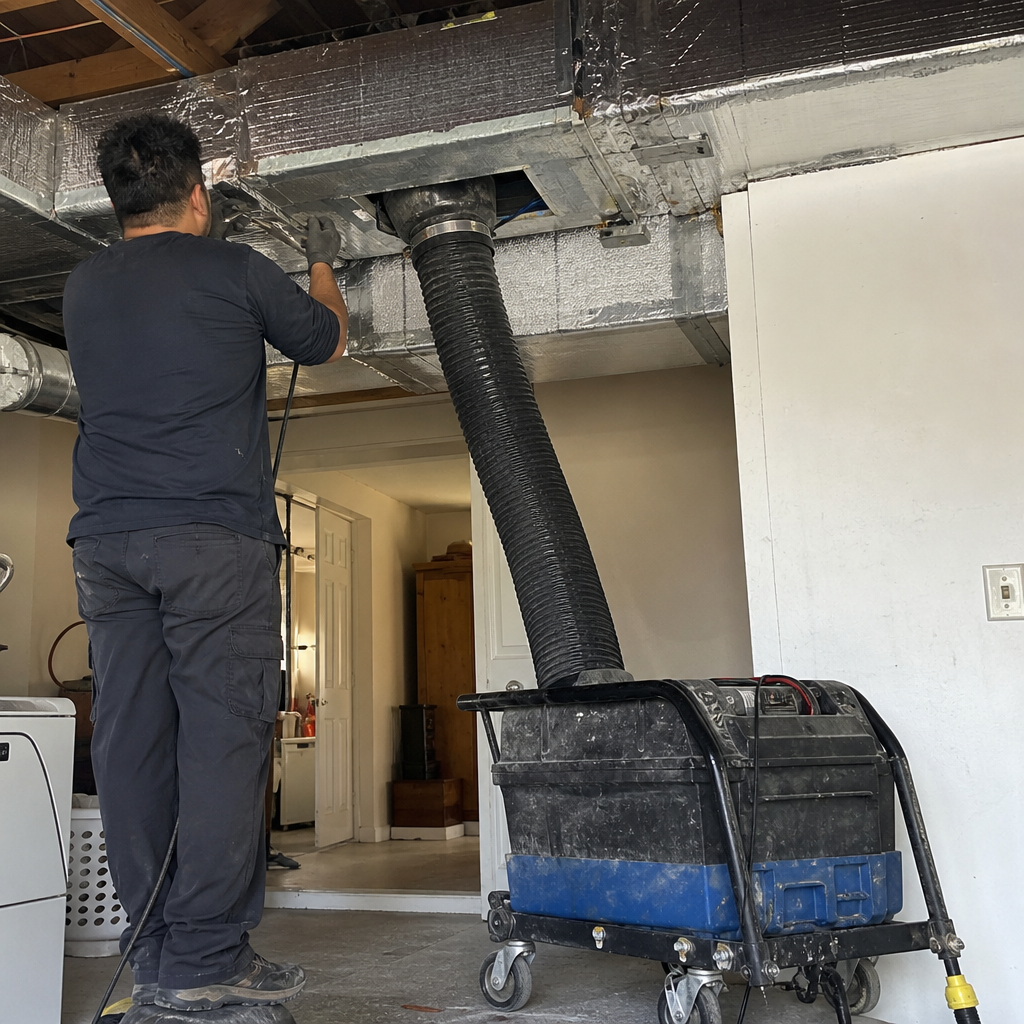
The answer tells you how much mechanical agitation power the company brings to the job. Professional duct cleaning requires two things: agitation (something that physically dislodges debris from the duct walls) and extraction (something that pulls that debris out of your home under negative pressure). Agitation separates the dirt from the surface. Extraction removes it from the air stream. Both are non-negotiable.
A Shop-Vac produces neither. A portable consumer carpet cleaner pressed into service produces neither. Purpose-built equipment – the kind used by companies that do this every day – includes systems like Rotobrush and Nikro. These are industry names. They have powered agitation heads and dedicated filter systems designed for duct interiors. A contractor who can name their equipment brand is a contractor who owns real equipment. A contractor who says “we have everything we need on the truck” without naming it is a contractor you should pass on.
Question 2: “What’s the CFM rating on your negative air machine?”
CFM stands for cubic feet per minute – the volume of air the extraction system moves. This is the single most telling technical question you can ask. Consumer vacuums move 100 to 200 CFM. That’s not enough to create meaningful negative pressure in a duct system. Professional negative-air machines used by legitimate duct cleaning companies operate at 1,000 CFM or higher, with many in the 2,000 to 4,000 CFM range. Abatement Technologies, a major manufacturer in this space, produces HEPA-filtered negative air units designed specifically for contaminant containment during duct cleaning.
The phrase to remember is “captured, not circulated.” A negative-air machine doesn’t just suck debris toward it; it creates a pressure differential that keeps the debris from escaping into your living space while the agitation head works. Without this, the cleaning process itself becomes a distribution event – dust that was settled in your ducts is now in your air. In an Orange home where the HVAC runs most of the year, that’s the opposite of what you’re paying for.
Question 3: “Will you show me before and after photos with a camera?”
This is the accountability question. Ducts are hidden. Without a camera inspection, you’re taking someone’s word that the inside of your ducts went from dirty to clean. A push-rod camera with a display screen is standard equipment for any serious duct cleaning operation. It costs a few thousand dollars, and a legitimate company owns one.
Before the job starts, the technician should run the camera through your main trunk lines and returns and show you what’s there. After the job, the same camera should show bare metal where dust, pet hair, and debris used to be. If a contractor can’t offer this, or offers it only “for an additional fee,” that’s not a contractor – that’s a gamble with your indoor air quality and your money.
Seven Red Flags That Signal a Bait-and-Switch Operation
The Orange duct cleaning market has a reputation problem, and it’s earned. The pattern is well-known: a low advertised price, a technician who arrives and immediately finds “mold” or “damage,” and a final invoice that has little relationship to the number in the ad. Here are the specific warning signs to watch for – any three of these, and you should cancel the appointment.
- The price is quoted per vent. Legitimate duct cleaning companies quote a flat rate for the entire system. Per-vent pricing is structured to make the final number unpredictable – you don’t know how many vents you have, but the contractor does. In Orange homes, which can easily have ten to twenty vents depending on square footage, per-vent pricing turns a “$49 special” into a four-hundred-dollar invoice before the job is half quoted.
- No camera inspection is offered, or it’s “not needed” if you ask. This is the single biggest tell. If a contractor can’t show you what’s in your ducts before and after, they’re betting you won’t check. What you can’t see, you can’t verify. What you can’t verify, you’re paying for on faith. Don’t pay on faith.
- The technician mentions “mold” within the first ten minutes. Mold in ducts is a real issue, but it requires moisture to grow, and most Orange homes have dry ductwork thanks to the climate. A technician who “finds” mold immediately is setting up an urgent upsell. If mold is genuinely suspected, you want a laboratory swab test sent to a third party for confirmation – not panic pricing from someone with a scrub brush.
- “Access point cuts” are never mentioned. Professional duct cleaning sometimes requires cutting small access ports into the ductwork to get tools into branch lines. A real contractor will explain this before the job and show you the sealed, insulated ports afterward. A contractor who never mentions access points is either not planning to clean the branch lines properly, or planning to cut holes without telling you.
- The price quote has no written breakdown. One number on a verbal quote with no line items sounds simple. It’s actually the opposite of simple – it’s unaccountable. A real scope of work lists what’s included, what the flat price covers, and what (if anything) would trigger a change order. If you can’t see what you’re buying, you’re not buying a service. You’re buying a story.
- Pressure to book “right now” for a “today-only” discount. Legitimate duct cleaning companies in Orange schedule work days or weeks out. Urgency is a sales tactic designed to bypass the questions in this guide. A real contractor doesn’t need you to decide before you hang up.
- The company has no physical address in Orange, just a phone number. A business that exists only as a phone number and a website can vanish after a bad job. A local operation with a real address, real equipment, and a real reputation is accountable. When you call Crisp Duct Cleaning home is a brick-and-mortar Orange operation – and that matters when something goes wrong and you need to reach a human.
NADCA Membership: What It Actually Means and What It Doesn’t Cover
NADCA – the National Air Duct Cleaners Association – is the industry’s main professional body, and verifying a contractor’s NADCA membership is a reasonable first filter. But it’s worth understanding precisely what that membership does and doesn’t prove, because too many homeowners treat it as a complete answer.
What NADCA membership does require: member companies must follow the ACR (Assessment, Cleaning, and Restoration) Standard, which is the most widely accepted technical standard for HVAC system cleaning in North America. The standard specifies the minimum requirements for cleaning methodology, containment, and results. Members are expected to carry proper equipment, train their technicians, and complete jobs to a defined verification standard. That’s real. It’s not marketing fluff – it’s a documented technical bar that a legitimate company has committed to meeting.
What NADCA membership does NOT cover: your specific home, your specific ducts, or the specific technician who shows up. NADCA doesn’t inspect every job a member performs. Membership doesn’t guarantee the technician assigned to your Orange home is trained, experienced, or even in a good mood that day. It’s a strong signal, not a guarantee. Also, NADCA membership says nothing about whether the company can repair damaged ductwork – which is a separate capability entirely, and one that matters more than most homeowners realize.
The takeaway: verify NADCA membership as part of your vetting, but don’t stop there. Apply the equipment test from the previous section. Ask the camera question. Ask the CFM question. A NADCA member who can answer all three clearly has earned the membership. A NADCA member who can’t is a member in paperwork only.
Why You Should Hire a Contractor Who Also Does Duct Repair
Here’s a scenario we’ve seen play out in Orange homes more times than we can count, particularly in the 1970s and 1980s-era subdivisions where flex duct has aged past its effective life:
You hire a duct cleaning company. The technician runs the camera and finds a problem: a collapsed section of flex duct under the house, a disconnected return in the attic, or a torn section that’s been pulling crawlspace air into the system for years. The ducts are clean – but the system is still compromised. The cleaning company says “that’s not our scope” and recommends a contractor. Now you’re paying for a second appointment, a second dispatch fee, and a second set of logistics. And in Orange’s competitive contractor market, you might wait two weeks for that repair while your system runs with a known defect.
This is why Air Duct Repair in Orange capability should be on your hiring checklist. A contractor who cleans ducts and repairs them is a contractor who can complete the job. Problems found during the cleaning get diagnosed and fixed in the same visit, by the same technician who’s already under your house with the camera. There’s no handoff, no second subcontractor, and no gap between knowing about a problem and solving it.
How to confirm they’re not subcontracting: ask directly: “If you find damaged ductwork during the cleaning, who fixes it – your employee or a subcontractor?” A company with in-house repair capability will answer immediately with “we do.” A company that subcontracts will hedge, explain, or say “it depends.” Follow up with: “Will the same technician who cleaned the ducts do the repair?” If the answer is anything other than yes, factor in the time, cost, and coordination risk of managing a second vendor.
Subcontracting isn’t inherently dishonest. But it changes your risk profile. A subcontractor has no relationship with you, no incentive to honor the original scope, and no accountability to the company you hired. In-house repair means one phone number, one schedule, one point of accountability. For an Orange homeowner, that’s the difference between a job that gets done and a job that gets coordinated to death.
The Written Scope of Work: Line by Line
Before any cleaning starts, you should have a written document that specifies exactly what will be done, to what standard, and for what price. This isn’t bureaucracy – it’s the line between a defined job and an open-ended invoice. Here’s what a complete written scope of work should include, line by line. If any of these lines are missing, ask for them in writing before you sign.
- Covered components: supply ducts, return ducts, main trunk lines, branch lines, plenums, the blower compartment, the evaporator coil, and the return air drop. If the scope says “all ductwork” but doesn’t list the coil or blower, that’s a gap – those components are part of the air stream and should be cleaned as part of the system.
- Equipment to be used, by brand name: “Rotobrush agitation system with HEPA-filtered negative air extraction at 2,200 CFM” tells you exactly what’s coming into your home. “Professional cleaning equipment” tells you nothing. This line also protects you: if the technician arrives with less than what’s written, the written scope is your evidence.
- Containment method: how will the contractor prevent debris from migrating into your living space during the job? The answer should reference negative air pressure and HEPA filtration. “We lay down drop cloths” is not containment – it’s cosmetically protecting your floors while the dust goes up your nose.
- Access point policy: will access cuts be made in the ductwork? Where? How many? And critically, how will they be sealed afterward? A proper seal is metal or rigid board with foil tape, not duct tape, which degrades within a year or two.
- Camera verification clause: before-and-after photos or video of every major duct run, provided to you at the end of the job. This is your proof of work. Without it, “cleaned” is a claim you take on faith.
- Flat price for the entire system: one number. No per-vent math. No “additional fees may apply.” If the contractor discovers damaged ductwork during the job, the scope should specify that repair work is quoted separately and only done with your written approval. This is the protection against the bait-and-switch: the cleaning price is fixed up front; the repair price is approved before work proceeds.
- What’s NOT included: a clear statement of exclusions prevents surprise add-ons. Ozone treatments are a common upsell that has no place in a legitimate duct cleaning. The same goes for “duct sanitizing” with unspecified antimicrobial products. If a service has a separately named line item, you should know about it before the van parks in your driveway.
- Duration estimate: a full-system cleaning on a typical Orange single-family home takes three to five hours. If the scope says ninety minutes, the contractor is not doing the job described.
A contractor who produces this document without being asked has process discipline. A contractor who resists when you ask for it has something to hide. Either way, you’ve learned what you need to know.
What Makes the Orange, CA Market Different
Orange sits in a unique HVAC position within Southern California. Unlike coastal cities where marine layers moderate temperatures much of the year, Orange – like most inland Orange County communities – experiences long, hot summers where air conditioning is not a luxury but a survival strategy. Systems here run ten to eleven months a year, which means ductwork sees near-constant airflow velocity. Anything loose inside those ducts gets circulated, filtered, re-circulated, and re-distributed on a continuous cycle.
Housing stock matters too. Orange has a significant inventory of homes built from the 1950s through the 1990s, and duct systems in those homes show it. Galvanized steel ducts in original 1960s homes have had sixty years to accumulate dust films. Flex duct installed in 1980s additions has often sagged, separated, or been compromised by rodents looking for a warm, dark place to nest. If you live in one of Orange’s older neighborhoods – the areas around Old Towne, the tree-lined streets near Hart Park – your ducts are not new, and they’ve likely never been properly cleaned.
There’s also a renovation factor at play. Orange’s real estate market runs hot, and turnover means renovation. Drywall dust, carpet fibers, paint overspray, and construction debris find their way into return air registers during any significant remodel. If you’ve had work done in the past five years and never had the ducts cleaned afterward, that debris is still there.
The practical upshot: Orange homeowners should think of duct cleaning not as an optional maintenance task but as a periodic system reset, the same way you’d flush a water heater or change timing belts. The question isn’t whether your ducts are dirty. The question is how dirty, and whether you’re going to verify the answer with a camera before you write a check.
Air Duct Cleaning in Orange is not a commodity service here. The quality difference between a real negative-air cleaning and a surface vacuum job is the difference between measurable air quality improvement and a placebo. In a climate where your HVAC runs this much, placebo is expensive.
Common Mistakes to Avoid
- Hiring on price alone. In Orange, the gap between a $49 whole-house ad and a $400 professional cleaning is not greed. It’s equipment, time, and camera verification. The cheap price is cheap because there’s no machine doing real extraction, no camera documenting the job, and no technician spending more than an hour in your home.
- Skipping the camera inspection. If you don’t see before and after footage of your own ducts, you don’t know what happened. This is the most common mistake, and the easiest one to avoid: simply require it.
- Treating “NADCA member” as a complete vetting process. Membership is a real signal, but it’s not a certificate of competence for every individual technician. Apply the equipment test anyway. Legitimate companies welcome the questions.
- Hiring a cleaner who doesn’t repair. Cleaning is only useful if the system is intact. If your ducts have damage, a clean but compromised system is still pulling attic or crawlspace air into your home. You’ll pay twice to fix a problem one company could have solved in a single visit.
- Not checking dryer vents at the same time. Orange homeowners think about air conditioning, but dryer fires don’t care about climate. A clogged dryer vent is one of the leading causes of residential fires nationwide, and it’s a separate system from your HVAC ducts. A company that offers Dryer Vent Cleaning in Orange as a standalone service treats it as the safety job it is – not a “$29 add-on” to a bigger ticket.
- Thinking duct cleaning is a one-time event. It isn’t. Ducts get dirty again – from pets, from renovations, from the normal operation of an HVAC system that runs most of the year. Most Orange homes should plan on a full-system cleaning every three to five years, depending on household factors.
- Not asking about access points before work starts. Access cuts are standard practice on many systems, but you should know where they’ll be made and how they’ll be sealed before the cutting starts. A contractor who plans access points is a contractor who’s actually cleaning your branch lines, not just the easy trunk sections.
When to Call a Professional
If you’ve lived in your Orange home for three or more years without a duct cleaning, it’s time. If you’ve completed a renovation and never had the ducts cleaned afterward, it’s past time. If you notice visible dust accumulation on vent covers, uneven airflow between rooms, or a persistent musty odor that doesn’t resolve with fresh air, those are system-level signals that shouldn’t be ignored. And if you haven’t had your dryer vent cleaned in over a year, that’s a fire-safety issue independent of anything happening in your HVAC system.
Crisp Duct Cleaning offers free estimates in Orange – call (833) 593-4428 to schedule a camera inspection and get a flat price per system before any work begins.
Frequently Asked Questions
A professional full-system cleaning in Orange typically runs $350 to $650 for an average single-family home, depending on square footage, number of systems, and accessibility – see our Air Duct Cleaning Cost Breakdown: The Orange Homeowner’s Reference for 2026 for full pricing details. That price should include the supply and return ducts, main trunk lines, branch lines, blower compartment, and a camera verification at the end. Anything under $150 for a “whole house” cannot cover real equipment, real time, and real verification. Call (833) 593-4428 for an exact quote – estimates are free.
Because they’re not doing the same job. A $49 or $99 whole-house special typically uses a portable consumer vacuum, takes under an hour, makes no access cuts into branch lines, and provides no camera verification. The work doesn’t extract contaminants from the system; it redistributes them. Those quotes are not cheaper versions of professional cleaning – they’re a different service entirely, and one that leaves your ducts no cleaner than they started.
Camera verification is the answer. A push-rod camera run through your main trunk lines before and after the job shows bare metal where dust, hair, and debris used to be. Ask for the footage before the technician leaves. If you can see the difference inside your own ducts, the work is done. If you can’t see it, assume it wasn’t. This is the standard any legitimate Orange duct cleaner should meet without hesitation.
Every three to five years for most Orange homes, with adjustments based on household factors: pets that shed, indoor smoking or vaping, recent renovations, allergies or respiratory conditions, or family members with compromised immune systems all argue for the shorter end of that range. If your home has central air and the system runs most of the year, annual inspection – not necessarily cleaning – is worth considering.
No. NADCA membership is voluntary, which is why its presence is a signal rather than a guarantee. California has no specific duct-cleaning license, and while NADCA sets the industry’s most widely accepted technical standards, membership doesn’t replace your own due diligence. Ask about equipment, camera inspection, and written scope even when NADCA membership is confirmed.
Some can, and you should hire one that does. Air Duct Repair capability means problems found during cleaning – collapsed flex duct, disconnected returns, rodent damage – get fixed in the same visit by the same technician. If your cleaner has to call a third party, you’ll wait longer and pay for a second dispatch. Always ask directly: “Who fixes it if you find damage?”
The Bottom Line
Hiring an air duct cleaning contractor in Orange comes down to this: the industry’s lack of licensing means the quality gap between a professional and a pretender is invisible until the work is done. The way to see it ahead of time is to ask hard questions about equipment, CFM ratings, camera verification, and written scope. A real contractor answers all of them without blinking. A pretender flinches. In a climate where your HVAC runs eleven months a year, the quality of that answer matters more than the number on the quote. Do the homework once, find a company that passes the test, and keep them – then explore our more guides & resources to protect your home year-round. Your ducts, your air, and your Orange home will show the difference.
Written by the team at Crisp Duct Cleaning, serving Orange since 2012.